
Common white wave
Cabera pusaria
Name means: “pusaria comes from a word for the delicate skin of a girl”

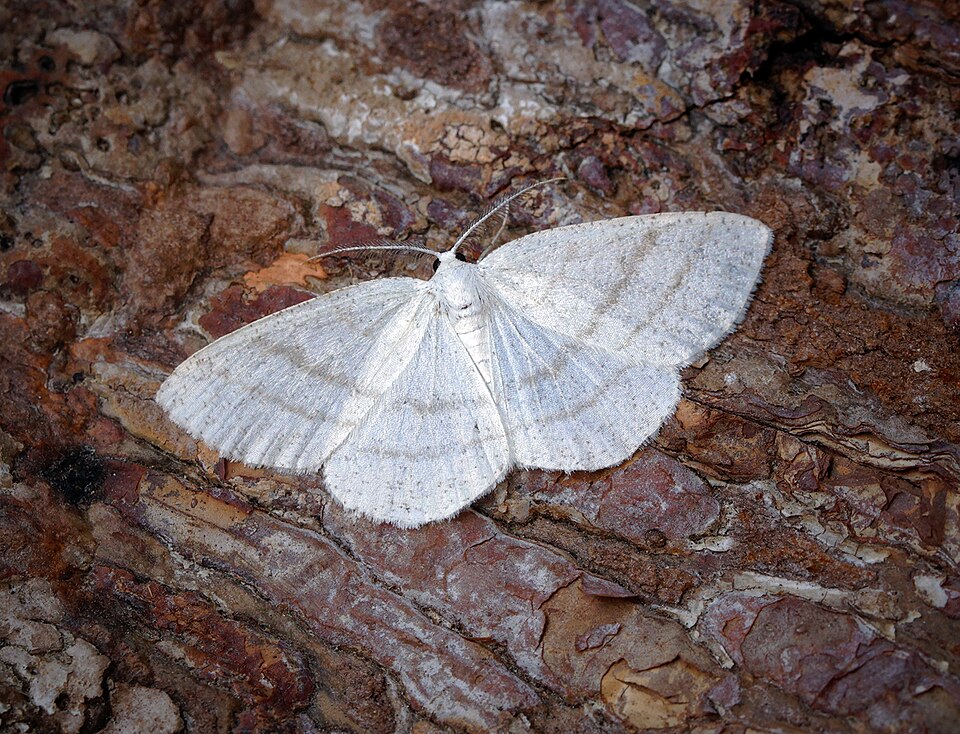
The common white wave is a delicate white moth with thin grey lines across its wings, a bit like ripples on water. Sometimes its wings have a soft pink glow. It flies at night in leafy forests.
Lives in
Europe and northern Asia, in leafy forests
Wingspan
3.2 to 3.5 cm (1.3 to 1.4 in)
Can it hurt you?
Harmless
Harmless. It does not bite or sting.
What does it eat?
Its caterpillars eat the leaves of trees and bushes such as alder, aspen, birch, oak, rowan and willow.
How big is it?
How wide are its wings?
🍚wings as wide as 6 grains of rice in a row⚽could fly across a whole football pitch in 29 seconds
How big is Common white wave compared to YOU?
Just maths in your browser. Nothing is saved or sent anywhere.
How fast is it?
A person walking about 5 km/h (3.1 mph)
A kid running fast about 13 km/h (8.1 mph)
Common white wave about 13 km/h (8.1 mph)
A grown-up on a bike about 25 km/h (16 mph)
cool stuff
Fun facts
1
Its caterpillars come in many colours, from green to purplish brown, grey or yellowish.
2
It spends the winter as a pupa, waiting for spring.
3
At night it is drawn to lights.
4
Grown-up moths can be seen from May to August.
you asked
Most asked questions about Common white wave
?What does the common white wave eat?
Its caterpillars eat leaves of trees like birch, alder, oak, willow and rowan.
?When can you see the common white wave?
From May to August, mostly at night near lights.
For bug experts
- Scientific name
- Cabera pusaria
- Named by
- Linnaeus, 1758
- Group
- Moths
- Family
- Geometridae
- Classification
- Insecta > Lepidoptera > Geometridae
- Lives on
- Europe, Asia
Where the facts come from
- Common white wave (Wikipedia, CC BY-SA 4.0): what it looks like, where it lives, what it eats, sizes and fun facts, retold in simple words.
- Picture by Ben Sale from UK. CC BY 2.0, Wikimedia Commons. The sticker of this bug is drawn from this picture.
If we got something wrong, sorry, we are bug fans, not a science journal. Tell us at [email protected] and we will fix it.
Bug Wiki honey jar For grown-ups: Bug Wiki is free, with no ads and no tracking. A small tip helps keep it online.Leave a tip Atlas moth
 Luna moth
 Hummingbird hawk-moth
 Domestic silk moth
 Isabella tiger moth
 Polyphemus moth
 Birch catkin bug
 Pale green weevil
 Hercules ant
 Say's firefly
 Eucalyptus longhorn borer
 Lorquin's admiral
_Common_White_Wave_(Cabera_pusaria)_(35099103546).jpg)