
French paper wasp

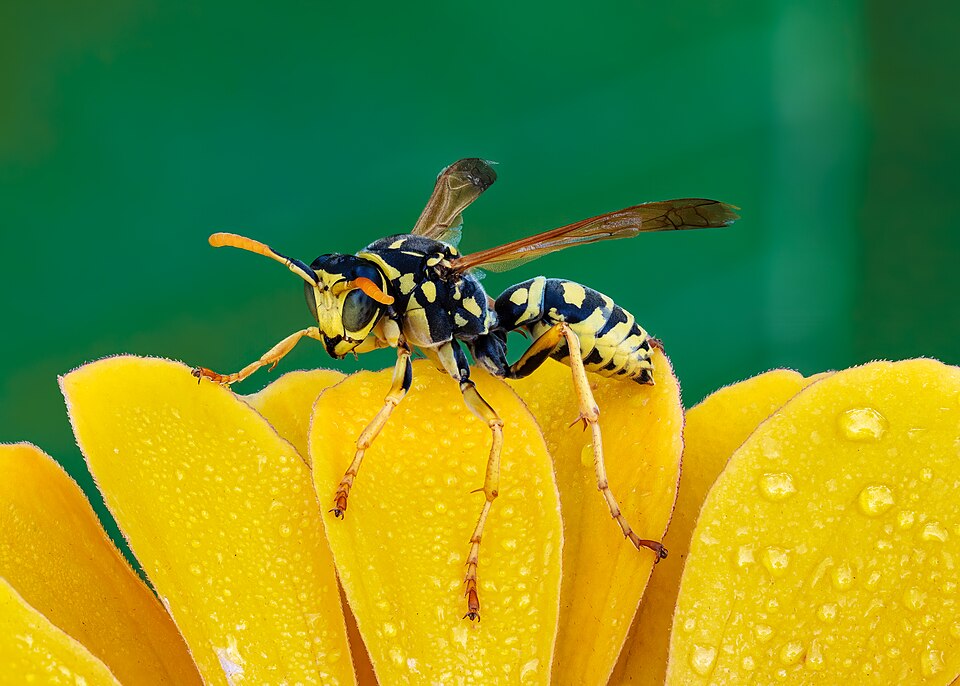
The French paper wasp is a slim yellow and black wasp. It builds its nest from paper that it makes itself, by mixing chewed plant fibres with its spit. The nest is a little umbrella of six-sided cells hanging from one stalk.
How fast is it?
Fun facts
In warm, dry places it hangs its nest out in the open with the cells facing down. North of the Alps it hides its nest in pipes or old metal.
In spring a single queen starts the nest alone. Her first daughters become workers that help her.
In the best spots a nest can grow to more than 1,000 cells.
Its eggs hatch after about two weeks, and the young wasps come out of their cocoons 10 to 14 days after pupating.
It looks so much like the European paper wasp that for years scientists mixed the two up.
Most asked questions about French paper wasp
?What is a paper wasp nest made of?
Chewed plant fibres mixed with the wasp's saliva, which dries into a kind of paper.
For bug experts
- Scientific name
- Polistes gallicus
- Group
- Wasps and hornets
- Family
- Vespidae
- Classification
- Insecta > Hymenoptera > Vespidae
- Lives on
- Europe, Africa
Where the facts come from
- Polistes gallicus (Wikipedia, CC BY-SA 4.0): what it looks like, where it lives, what it eats, sizes and fun facts, retold in simple words.
- Picture by Ermell. CC BY-SA 4.0, Wikimedia Commons. The sticker of this bug is drawn from this picture.
If we got something wrong, sorry, we are bug fans, not a science journal. Tell us at [email protected] and we will fix it.
Bug Wiki honey jar For grown-ups: Bug Wiki is free, with no ads and no tracking. A small tip helps keep it online.Leave a tip European hornet
 Northern giant hornet
 Bald-faced hornet
 Red velvet ant
 Eastern cicada killer
 Asian hornet
 Pale mottled willow moth
 Clouded drab
 Canary red admiral
 Wedgling moth
 Eastern dotted border
 Barbut's cuckoo bumble bee