
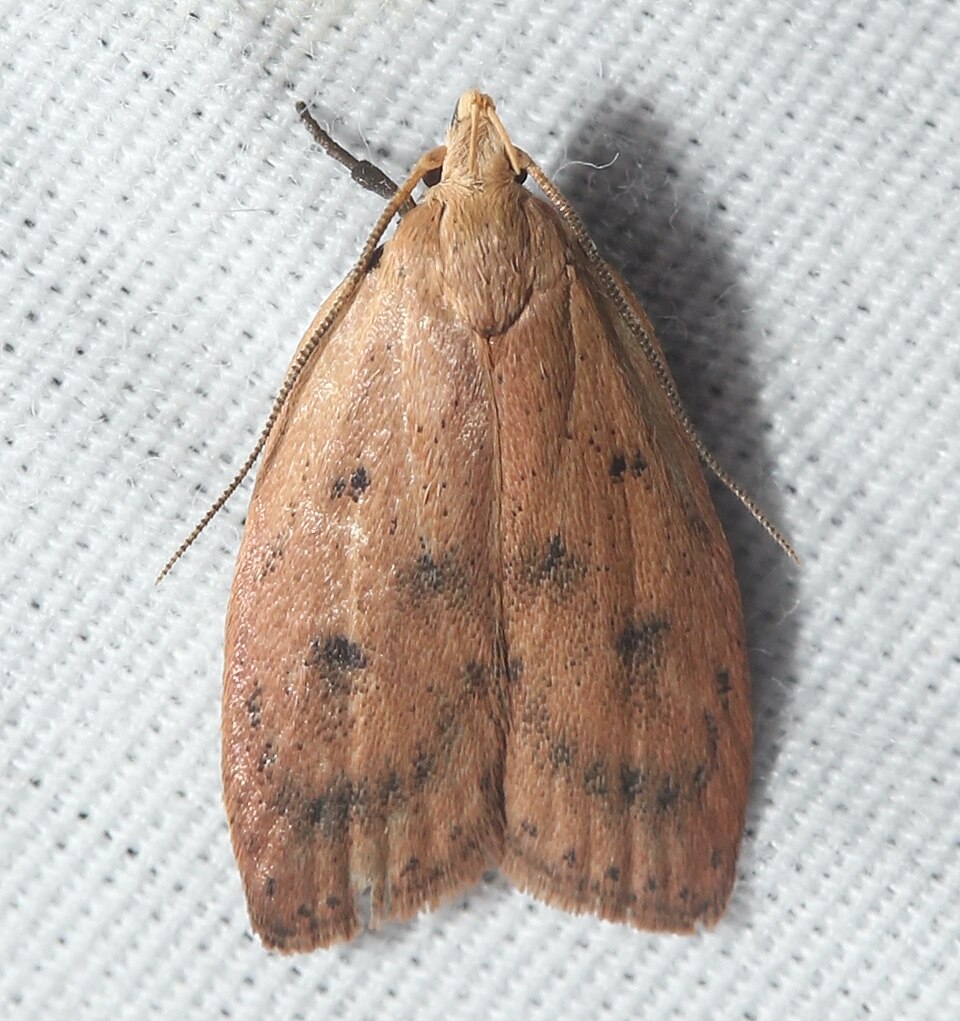
Gold-striped leaftier moth
Machimia tentoriferella
Name means: “from the Latin word for tent, because its caterpillar makes a tent out of leaves”

The gold-striped leaftier moth is a small autumn moth. Its caterpillar is a little builder. It rolls or ties leaves together to make a cosy tent to hide in.
Lives in
Eastern North America, from Nova Scotia to North Carolina and west to Iowa, in woods
Wingspan
2 to 2.6 cm (0.79 to 1 in)
Can it hurt you?
Harmless
Harmless. It cannot bite or sting.
What does it eat?
Its caterpillars eat the leaves of ash trees, and also birch, maple, oak, cherry, apple and many other trees.
How big is it?
How wide are its wings?
🍚wings as wide as 4 grains of rice in a row⚽could fly across a whole football pitch in 34 seconds
How big is Gold-striped leaftier moth compared to YOU?
Just maths in your browser. Nothing is saved or sent anywhere.
How fast is it?
A person walking about 5 km/h (3.1 mph)
Gold-striped leaftier moth about 11 km/h (6.8 mph)
A kid running fast about 13 km/h (8.1 mph)
A grown-up on a bike about 25 km/h (16 mph)
cool stuff
Fun facts
1
The moths fly in September and October, when many other moths are gone.
2
Its caterpillars can eat the leaves of more than 15 kinds of trees and bushes.
3
Even lilac and dogwood bushes are on its menu.
you asked
Most asked questions about Gold-striped leaftier moth
?What does the gold-striped leaftier eat?
Its caterpillars eat the leaves of ash, birch, maple, oak and many other trees.
?Is the gold-striped leaftier moth dangerous?
No. It is a harmless moth.
For bug experts
- Scientific name
- Machimia tentoriferella
- Group
- Moths
- Family
- Depressariidae
- Classification
- Insecta > Lepidoptera > Depressariidae
- Lives on
- North America
Where the facts come from
- Machimia tentoriferella (Wikipedia, CC BY-SA 4.0): what it looks like, where it lives, what it eats, sizes and fun facts, retold in simple words.
- Picture by NCBioTeacher. CC0, Wikimedia Commons. The sticker of this bug is drawn from this picture.
If we got something wrong, sorry, we are bug fans, not a science journal. Tell us at [email protected] and we will fix it.
Bug Wiki honey jar For grown-ups: Bug Wiki is free, with no ads and no tracking. A small tip helps keep it online.Leave a tip Atlas moth
 Luna moth
 Hummingbird hawk-moth
 Domestic silk moth
 Isabella tiger moth
 Polyphemus moth
 Shadow snail
 Yellow wig gall wasp
 Iberian saw bush-cricket
 Clustered gall wasp
 Striped volcano gall wasp
 Crystalline gall wasp