
Lancet clubtail
Phanogomphus exilis
Name means: “the boy's tail clasps are shaped like a lancet, a small pointed knife”

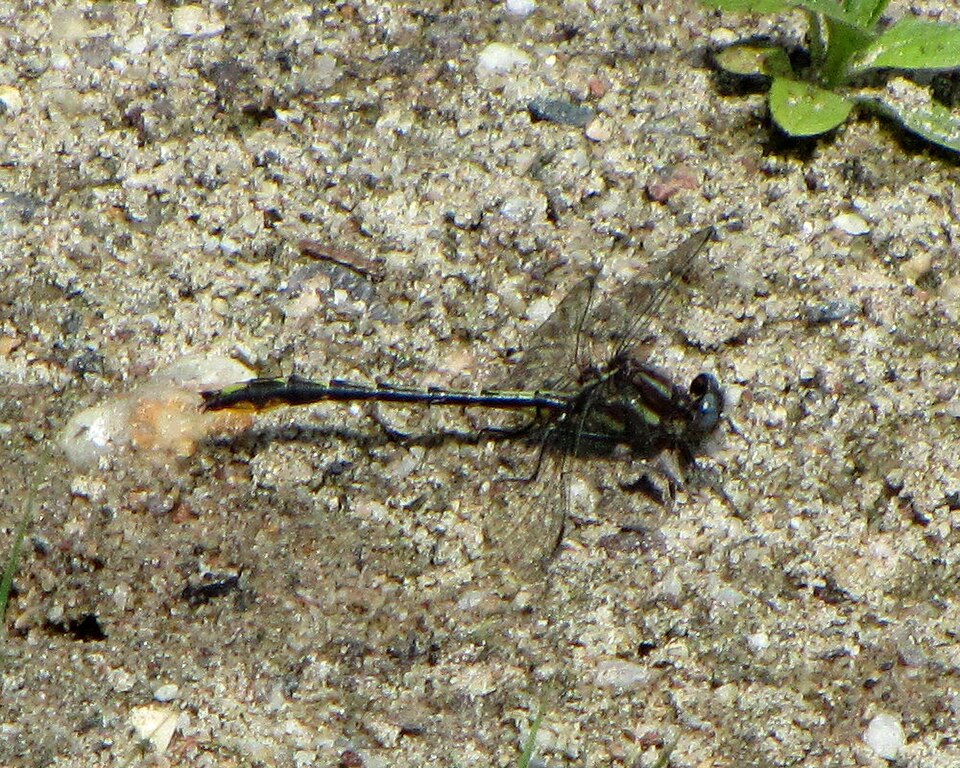
The lancet clubtail is a black dragonfly with green stripes on its chest and green triangles down its long tail. Near the tip of the tail it has yellow patches on the sides. It is common around waters in Canada and the northeastern United States.
Lives in
Southern Canada and the northeastern United States, near water
Length
4.3 cm (1.7 in)
Can it hurt you?
Harmless
Harmless. Dragonflies have no sting.
What does it eat?
It catches small flying insects in the air. Its babies live in the water and hunt tiny water animals.
How big is it?
How long is it?
🍚as long as 7 grains of rice in a row⚽could fly across a whole football pitch in 11 seconds⚡moves 220 times its own body length every second
How big is Lancet clubtail compared to YOU?
Just maths in your browser. Nothing is saved or sent anywhere.
How fast is it?
A kid running fast about 13 km/h (8.1 mph)
A grown-up on a bike about 25 km/h (16 mph)
Lancet clubtail about 34 km/h (21 mph)
A car driving in town about 50 km/h (31 mph)
cool stuff
Fun facts
1
Grown-ups fly in June and July.
2
There are lots of lancet clubtails, and their numbers are steady.
3
Its babies grow up under water and later climb out to become flying dragonflies.
you asked
Most asked questions about Lancet clubtail
?Is the lancet clubtail dangerous?
No. It is a dragonfly, and dragonflies have no sting.
?How big is the lancet clubtail?
It is about 4.3 centimetres long.
For bug experts
- Scientific name
- Phanogomphus exilis
- Group
- Dragonflies and damselflies
- Family
- Gomphidae
- Classification
- Insecta > Odonata > Gomphidae
- Lives on
- North America
Where the facts come from
- Phanogomphus exilis (Wikipedia, CC BY-SA 4.0): what it looks like, where it lives, what it eats, sizes and fun facts, retold in simple words.
- Picture by D. Gordon E. Robertson. CC BY-SA 3.0, Wikimedia Commons. The sticker of this bug is drawn from this picture.
If we got something wrong, sorry, we are bug fans, not a science journal. Tell us at [email protected] and we will fix it.
Bug Wiki honey jar For grown-ups: Bug Wiki is free, with no ads and no tracking. A small tip helps keep it online.Leave a tip Emperor dragonfly
 Common whitetail
 Green darner
 Ebony jewelwing
 Globe skimmer
 Blue dasher
 Greenhead horse fly
 Banded mosquito
 Great diving beetle
 Water louse
 New Zealand mud snail
 Giant mayfly