
Saddled leafhopper
Colladonus clitellarius
Name means: “back-saddled”

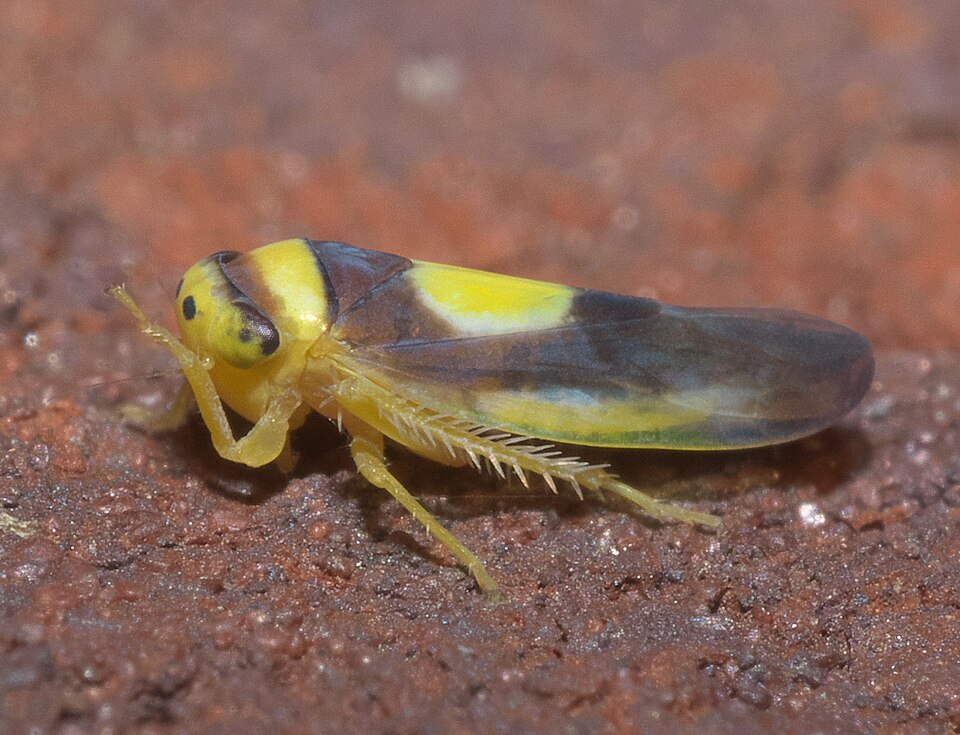
The saddled leafhopper is a tiny brown and black bug with a bright green mark on its back. The mark looks like a little saddle. Even its eyes are striped in two colours.
Lives in
Eastern North America, mostly in forests of the north-eastern United States and south-eastern Canada
Length
5 to 6 mm (0.2 to 0.24 in)
Can it hurt you?
Harmless
Harmless to people. It can carry a disease that makes peach trees sick.
What does it eat?
It sucks sap from plants such as willows and honey locust trees.
How big is it?
How long is it?
💅small enough to sit on your fingernail🍽️could run across a dinner table in 4.1 seconds⚡moves 40 times its own body length every second
How big is Saddled leafhopper compared to YOU?
Just maths in your browser. Nothing is saved or sent anywhere.
How fast is it?
A tortoise about 0.3 km/h (0.19 mph)
Saddled leafhopper about 0.87 km/h (0.54 mph)
A person walking about 5 km/h (3.1 mph)
A kid running fast about 13 km/h (8.1 mph)
cool stuff
Fun facts
1
The males are often a little smaller than the females.
2
Its babies look like the grown-ups but paler and blotchy.
3
You can see the grown-ups from May to November.
4
It can spread a germ called cherry X disease to peach trees.
you asked
Most asked questions about Saddled leafhopper
?Why is it called the saddled leafhopper?
Because of the green saddle-shaped mark on its back. Its scientific name means the same.
?How big is the saddled leafhopper?
Only 5 to 6 millimetres long.
For bug experts
- Scientific name
- Colladonus clitellarius
- Group
- True bugs and cicadas
- Family
- Cicadellidae
- Classification
- Insecta > Hemiptera > Cicadellidae
- Lives on
- North America
Where the facts come from
- Colladonus clitellarius (Wikipedia, CC BY-SA 4.0): what it looks like, where it lives, what it eats, sizes and fun facts, retold in simple words.
- Picture by xpda. CC BY-SA 4.0, Wikimedia Commons. The sticker of this bug is drawn from this picture.
If we got something wrong, sorry, we are bug fans, not a science journal. Tell us at [email protected] and we will fix it.
Bug Wiki honey jar For grown-ups: Bug Wiki is free, with no ads and no tracking. A small tip helps keep it online.Leave a tip Pharaoh cicada
 Spotted lanternfly
 Brown marmorated stink bug
 Cochineal
 Boxelder bug
 Western conifer seed bug
 Oak hairstreak
 Splendid palpita moth
 Moorland ground beetle
 Sandhill carpenter ant
 Wood nettle gall midge
 Fig longhorn beetle