
Western earwig

The western earwig is a long, brown insect with a pair of pincers at the end of its body. It looks almost exactly like the common earwig, so even experts often mix them up. It hides in dark, damp places during the day.
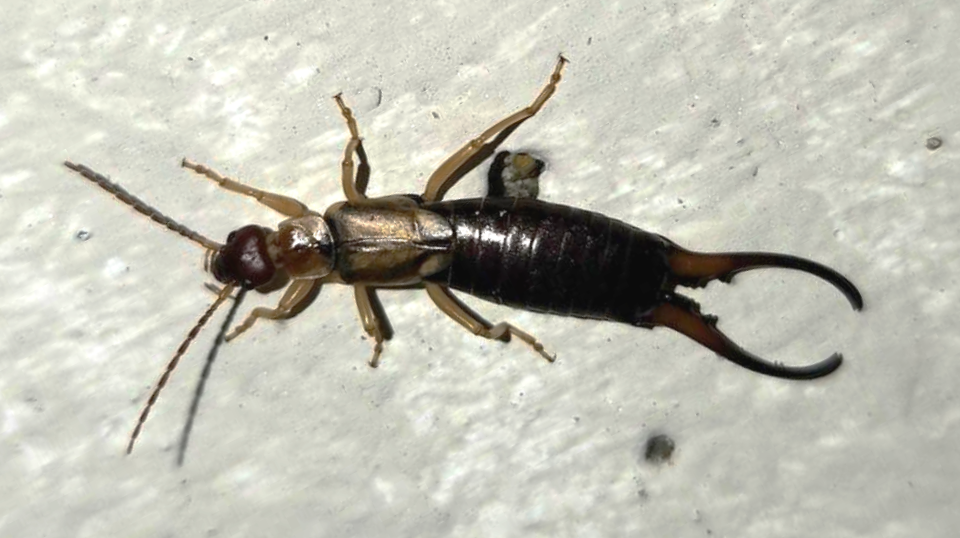
How fast is it?
Fun facts
For a long time scientists thought it was the same species as the common earwig.
It was first described by Johan Christian Fabricius in 1775.
It lives on several continents, from Europe to Australia and the Americas.
Most asked questions about Western earwig
?Do earwigs crawl into your ears?
No. That is just an old story. Earwigs prefer to hide under stones, bark and leaves.
?Can the western earwig hurt you?
No. Its pincers can only give a tiny pinch.
Myth buster
Myth: Earwigs crawl into people's ears while they sleep.
Truth: No. That is just an old story. Earwigs hide under stones, bark and leaves instead.
For bug experts
- Scientific name
- Forficula dentata
- Named by
- Fabricius, 1775
- Group
- Other insects
- Family
- Forficulidae
- Classification
- Insecta > Dermaptera > Forficulidae
- Lives on
- Europe, Australia and Oceania, South America, North America
- Also known as
- European earwig
Where the facts come from
- Forficula dentata (Wikipedia, CC BY-SA 4.0): what it looks like, where it lives, what it eats, sizes and fun facts, retold in simple words.
- Picture by Jiovanny Celis. CC BY 4.0, Wikimedia Commons. The sticker of this bug is drawn from this picture.
If we got something wrong, sorry, we are bug fans, not a science journal. Tell us at [email protected] and we will fix it.
Bug Wiki honey jar For grown-ups: Bug Wiki is free, with no ads and no tracking. A small tip helps keep it online.Leave a tip Common earwig
 Silverfish
 Chigoe flea
 Giant earwig
 Grannom
 Firebrat
 Pointillist neoscona
 Feather-legged fly
 Lesser yellow underwing
 Soybean looper moth
 Brazilian black-and-white tarantula
 Toadflax brocade moth