
Two-spined trap-jaw ant
Odontomachus haematodus

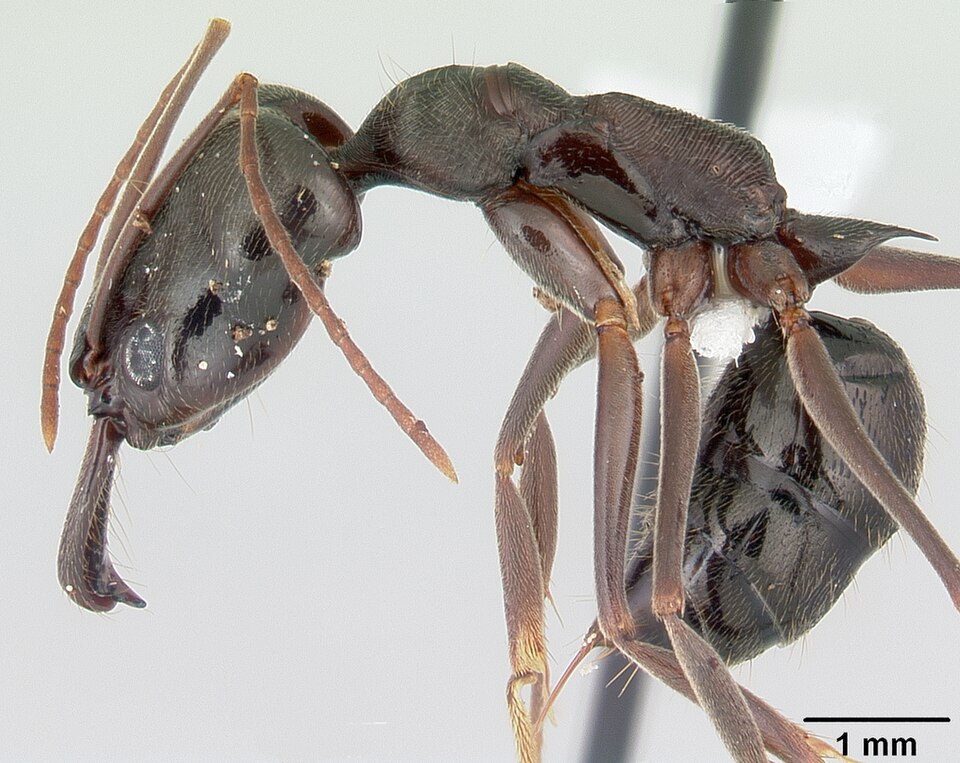
The two-spined trap-jaw ant has jaws that work like a snap trap. It holds them wide open and then snaps them shut in a flash to catch its food. It first comes from South America.
Lives in
South America, and brought to the United States
What does it eat?
It hunts other small animals with its snapping jaws. It is even known to catch frog tadpoles.
How fast is it?
A garden snail about 0.05 km/h (0.03 mph)
A tortoise about 0.3 km/h (0.19 mph)
Two-spined trap-jaw ant about 0.3 km/h (0.19 mph)
A person walking about 5 km/h (3.1 mph)
cool stuff
Fun facts
1
Workers go out looking for food in the daytime and at night too.
2
It usually builds its nest in rotting wood.
3
In some places it even makes its home inside plants.
4
It is known to eat the tadpoles of one kind of frog.
5
It has travelled from South America to the United States, where it now lives too.
you asked
Most asked questions about Two-spined trap-jaw ant
?Why is it called a trap-jaw ant?
Because it snaps its jaws shut very fast, like a trap, to catch food.
?Where does the two-spined trap-jaw ant live?
It comes from South America and now lives in the United States too.
For bug experts
- Scientific name
- Odontomachus haematodus
- Group
- Ants
- Family
- Formicidae
- Classification
- Insecta > Hymenoptera > Formicidae
- Lives on
- South America, North America
Where the facts come from
- Odontomachus haematodus (Wikipedia, CC BY-SA 4.0): what it looks like, where it lives, what it eats, sizes and fun facts, retold in simple words.
- Picture by April Nobile. CC BY 4.0, Wikimedia Commons. The sticker of this bug is drawn from this picture.
If we got something wrong, sorry, we are bug fans, not a science journal. Tell us at [email protected] and we will fix it.
Bug Wiki honey jar For grown-ups: Bug Wiki is free, with no ads and no tracking. A small tip helps keep it online.Leave a tip Black garden ant
 Bullet ant
 Pharaoh ant
 Argentine ant
 Red imported fire ant
 Yellow crazy ant
 Marbled white-spot
 Oak leafhopper
 Gold-striped leaftier moth
 Forest semilooper
 Spotted marsh fly
 Black-rimmed prominent