
Banded thintail
Meliscaeva cinctella

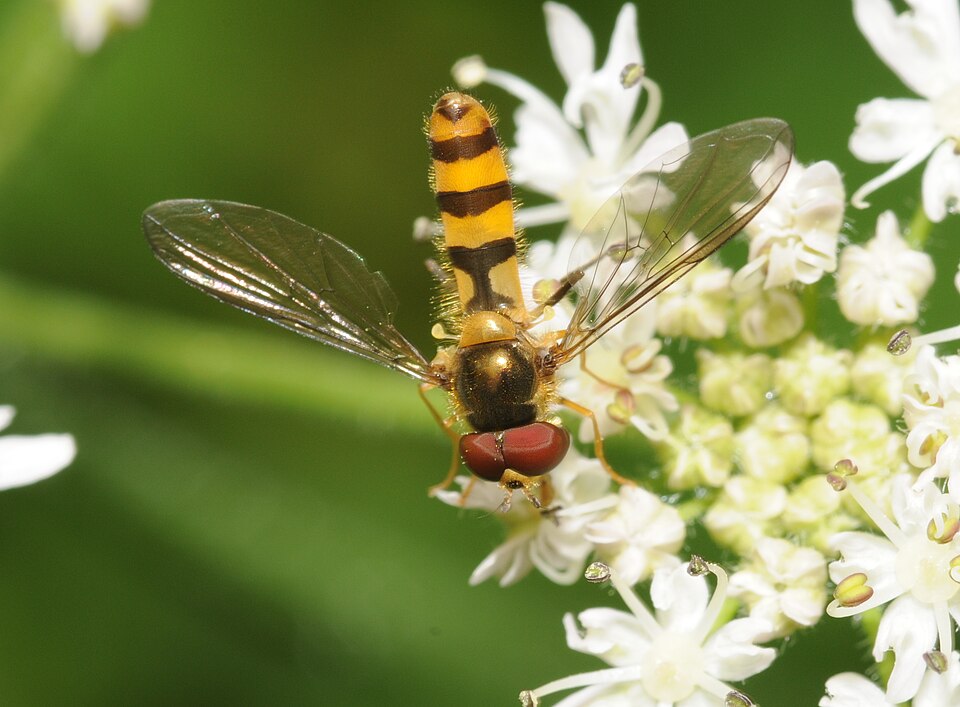
The banded thintail is a slim hoverfly with a long body and yellow bands on its belly. Its face is all yellow. It can hang still in the air, then zoom away to the next flower.
Lives in
Europe, Asia across to the Pacific coast, and North America from Alaska to California
Can it hurt you?
Harmless
Harmless. It is a fly and has no sting.
What does it eat?
Grown-ups visit flowers like dandelions, hawthorn and elder. The babies eat aphids on bushes and trees, so gardeners like them.
How fast is it?
A person walking about 5 km/h (3.1 mph)
A kid running fast about 13 km/h (8.1 mph)
Banded thintail about 14 km/h (8.7 mph)
A grown-up on a bike about 25 km/h (16 mph)
cool stuff
Fun facts
1
Each wing is about 7 to 10 millimetres long.
2
It visits lots of different flowers, from raspberries and elder to dandelions and goldenrod.
3
Its babies hunt aphids, the tiny bugs that suck sap from plants.
4
You can see it flying from April to September in forests, hedges, gardens and parks.
you asked
Most asked questions about Banded thintail
?Can the banded thintail sting?
No. It is a fly and has no sting, even though its yellow bands look a little like a wasp.
?What does the banded thintail eat?
Grown-ups visit flowers for nectar and pollen. The babies eat aphids.
For bug experts
- Scientific name
- Meliscaeva cinctella
- Group
- Flies and mosquitoes
- Family
- Syrphidae
- Classification
- Insecta > Diptera > Syrphidae
- Lives on
- Europe, Asia, North America
Where the facts come from
- Meliscaeva cinctella (Wikipedia, CC BY-SA 4.0): what it looks like, where it lives, what it eats, sizes and fun facts, retold in simple words.
- Picture by Thomas Bresson. CC BY 2.0, Wikimedia Commons. The sticker of this bug is drawn from this picture.
If we got something wrong, sorry, we are bug fans, not a science journal. Tell us at [email protected] and we will fix it.
Bug Wiki honey jar For grown-ups: Bug Wiki is free, with no ads and no tracking. A small tip helps keep it online.Leave a tip Housefly
 New World screwworm fly
 Lovebug
 Tsetse fly
 Common fruit fly
 Asian tiger mosquito
 Peppertree psyllid
 Common digging grasshopper
 White-banded bird-dropping spider
 Spotted grass moth
 Three-tooth bulin
 Small yellow-girdled tenthredo
_(11).jpg)