
Broad-headed marsh fly
Helophilus latifrons

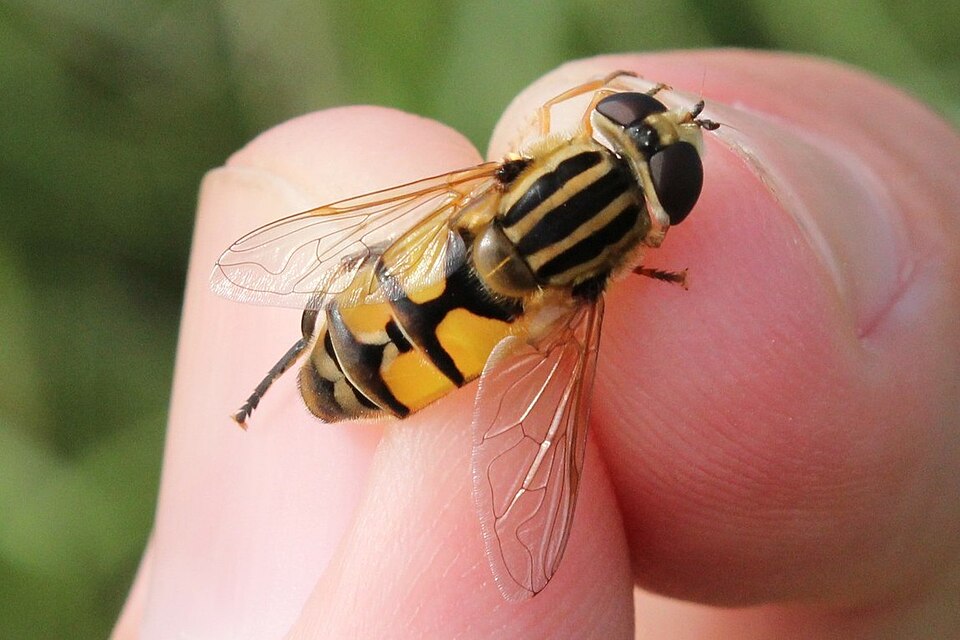
The broad-headed marsh fly is a hoverfly from North America. It spends lots of time on flowers. Its babies grow up in water, where they eat bits of old, rotting plants.
Lives in
The United States, southern Canada and the mountains of Mexico
Can it hurt you?
Harmless
Harmless. Hoverflies cannot sting or bite you.
What does it eat?
The grown-up fly drinks nectar and eats pollen from flowers. Its larvae live in water and eat rotting plants.
How fast is it?
A person walking about 5 km/h (3.1 mph)
A kid running fast about 13 km/h (8.1 mph)
Broad-headed marsh fly about 14 km/h (8.7 mph)
A grown-up on a bike about 25 km/h (16 mph)
cool stuff
Fun facts
1
Hoverflies can stay almost perfectly still in the air while they fly.
2
Grown-up hoverflies are also called flower flies, because they are so often found on flowers.
3
Nectar gives it energy, and pollen gives it protein to stay strong.
you asked
Most asked questions about Broad-headed marsh fly
?Is the broad-headed marsh fly dangerous?
No. It is a harmless hoverfly that cannot sting.
?Where do broad-headed marsh fly larvae live?
In water. They feed on old, rotting plants there.
For bug experts
- Scientific name
- Helophilus latifrons
- Named by
- Loew, 1863
- Group
- Flies and mosquitoes
- Family
- Syrphidae
- Classification
- Insecta > Diptera > Syrphidae
- Lives on
- North America
Where the facts come from
- Helophilus latifrons (Wikipedia, CC BY-SA 4.0): what it looks like, where it lives, what it eats, sizes and fun facts, retold in simple words.
- Picture by Quinten Wiegersma. CC BY 4.0, Wikimedia Commons. The sticker of this bug is drawn from this picture.
If we got something wrong, sorry, we are bug fans, not a science journal. Tell us at [email protected] and we will fix it.
Bug Wiki honey jar For grown-ups: Bug Wiki is free, with no ads and no tracking. A small tip helps keep it online.Leave a tip Housefly
 New World screwworm fly
 Lovebug
 Tsetse fly
 Common fruit fly
 Asian tiger mosquito
 Radiated wolf spider
 Corn earworm
 Asian swallowtail
 Glassy-winged sharpshooter
 Spined soldier bug
 Convolvulus hawk-moth