
Cardinal meadowhawk
Sympetrum illotum

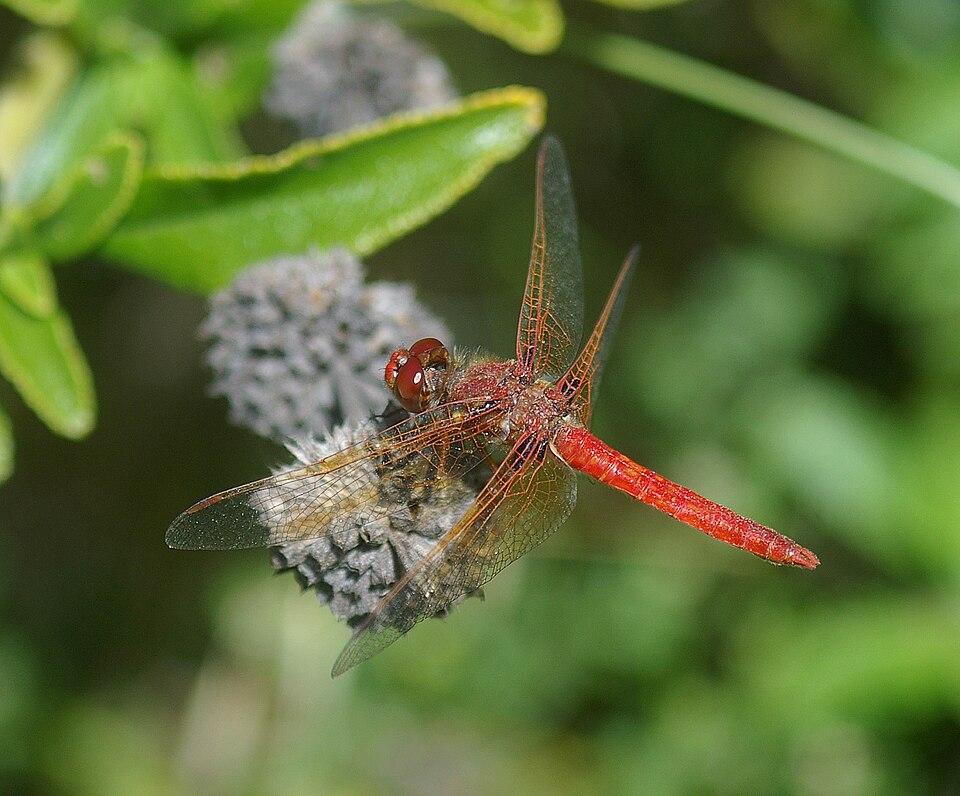
The cardinal meadowhawk is a dragonfly from the Americas. It belongs to the skimmer family, dragonflies that like to perch and then dart out after flying insects. Like all dragonflies, it starts life under water.
Lives in
North and South America, including Caribbean islands, near ponds and streams
Can it hurt you?
Harmless
Harmless. Dragonflies do not sting.
What does it eat?
It catches small flying insects in the air. Its young hunt little water animals.
How fast is it?
A kid running fast about 13 km/h (8.1 mph)
A grown-up on a bike about 25 km/h (16 mph)
Cardinal meadowhawk about 40 km/h (25 mph)
A car driving in town about 50 km/h (31 mph)
cool stuff
Fun facts
1
Scientists say it is not in danger, and the number of cardinal meadowhawks is steady.
2
There are three slightly different kinds of it in different places.
3
It lives on some islands in the Caribbean Sea too.
you asked
Most asked questions about Cardinal meadowhawk
?Is the cardinal meadowhawk dangerous?
No. Dragonflies are harmless to people and do not sting.
?Where does the cardinal meadowhawk live?
In North and South America and on some Caribbean islands, near water.
For bug experts
- Scientific name
- Sympetrum illotum
- Named by
- Hagen, 1861
- Group
- Dragonflies and damselflies
- Family
- Libellulidae
- Classification
- Insecta > Odonata > Libellulidae
- Lives on
- North America, South America
Where the facts come from
- Sympetrum illotum (Wikipedia, CC BY-SA 4.0): what it looks like, where it lives, what it eats, sizes and fun facts, retold in simple words.
- Picture by ALAN SCHMIERER. CC0, Wikimedia Commons. The sticker of this bug is drawn from this picture.
If we got something wrong, sorry, we are bug fans, not a science journal. Tell us at [email protected] and we will fix it.
Bug Wiki honey jar For grown-ups: Bug Wiki is free, with no ads and no tracking. A small tip helps keep it online.Leave a tip Emperor dragonfly
 Common whitetail
 Green darner
 Ebony jewelwing
 Globe skimmer
 Blue dasher
 Black-footed drone fly
 Marsh lady beetle
 Clipped-winged grasshopper
 Dark-winged chrysogaster
 Turkey brown
 Willow beaked-gall midge
_(5-28-06)_just_south_of_Morro_Bay_(536563729).jpg)