
Ferruginous bee-grabber
Sicus ferrugineus

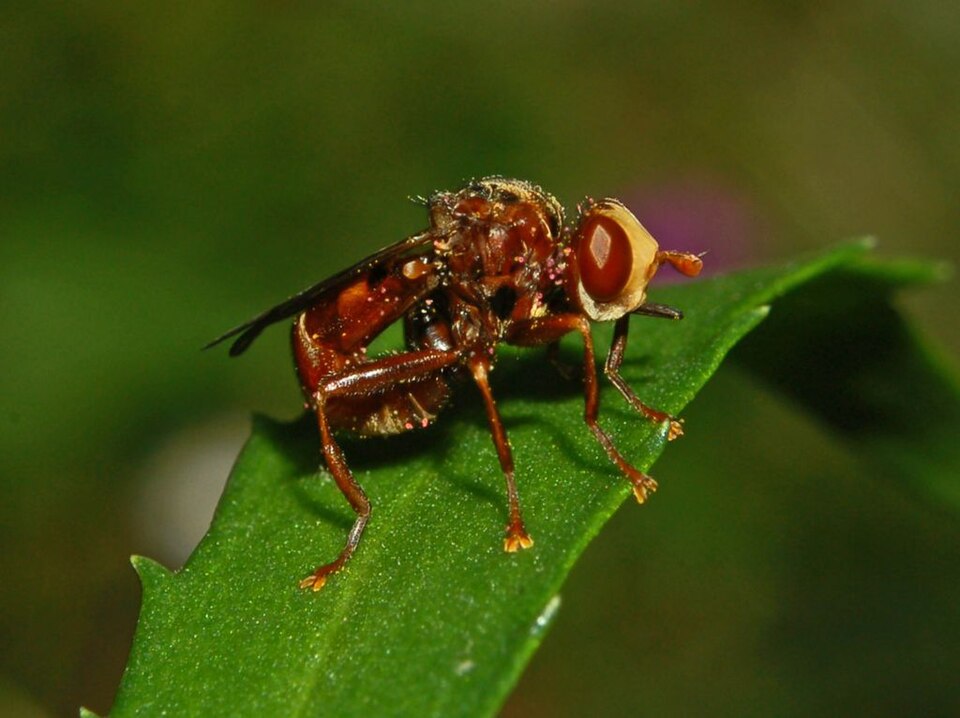
The ferruginous bee-grabber is a reddish brown fly with a big, puffy yellow head and red eyes. When it rests, it curls its long tail end forward under its body. It has a sneaky secret: its babies grow up inside bumblebees.
Lives in
Much of Europe, in hedgerows and flowery meadows
Length
0.8 to 1.3 cm (0.31 to 0.51 in)
Can it hurt you?
Harmless
Harmless to people. It does not bite or sting.
What does it eat?
Grown-ups drink nectar and eat pollen from flowers like thistles, hogweed and brambles. The larvae live inside bumblebees and feed on them.
How big is it?
How long is it?
🍚as long as 2 grains of rice in a row⚽could fly across a whole football pitch in 38 seconds⚡moves 210 times its own body length every second
How big is Ferruginous bee-grabber compared to YOU?
Just maths in your browser. Nothing is saved or sent anywhere.
How fast is it?
A person walking about 5 km/h (3.1 mph)
Ferruginous bee-grabber about 10 km/h (6.2 mph)
A kid running fast about 13 km/h (8.1 mph)
A grown-up on a bike about 25 km/h (16 mph)
cool stuff
Fun facts
1
Its larva lives inside a bumblebee and feeds on it from the inside.
2
The larva even spends the winter inside the bumblebee.
3
Its wings are clear but reddish yellow near the body.
4
You can see it from May to September.
you asked
Most asked questions about Ferruginous bee-grabber
?Why is it called a bee-grabber?
Because its babies grow up inside bumblebees.
?Is the bee-grabber dangerous to people?
No. It is harmless to people, it only troubles bumblebees.
For bug experts
- Scientific name
- Sicus ferrugineus
- Named by
- Linnaeus, 1761
- Group
- Flies and mosquitoes
- Family
- Conopidae
- Classification
- Insecta > Diptera > Conopidae
- Lives on
- Europe
Where the facts come from
- Sicus ferrugineus (Wikipedia, CC BY-SA 4.0): what it looks like, where it lives, what it eats, sizes and fun facts, retold in simple words.
- Picture by Hectonichus. CC BY-SA 3.0, Wikimedia Commons. The sticker of this bug is drawn from this picture.
If we got something wrong, sorry, we are bug fans, not a science journal. Tell us at [email protected] and we will fix it.
Bug Wiki honey jar For grown-ups: Bug Wiki is free, with no ads and no tracking. A small tip helps keep it online.Leave a tip Housefly
 New World screwworm fly
 Lovebug
 Tsetse fly
 Common fruit fly
 Asian tiger mosquito
 Western sheep moth
 Garden acraea
 Alfalfa weevil
 Southern paper wasp
 Rocky Mountain parnassian
 Great southern white