
Malaysian ladybird
Chilocorus nigritus

The Malaysian ladybird is a little ladybird from Southeast Asia that is a champion pest hunter. It eats scale insects, tiny bugs that suck the juice out of plants. People have taken it all over the world to protect their plants.
Lives in
First from Southeast Asia, now in many warm places around the world, in gardens and orchards
Can it hurt you?
Harmless
Harmless. It is a friendly ladybird that helps keep plants healthy.
What does it eat?
It hunts scale insects, tiny bugs that sit on plants and suck their juice.
How fast is it?
A kid running fast about 13 km/h (8.1 mph)
A grown-up on a bike about 25 km/h (16 mph)
Malaysian ladybird about 30 km/h (19 mph)
A car driving in town about 50 km/h (31 mph)
cool stuff
Fun facts
1
It is one of the most important hunters of scale insects.
2
People brought it to Hawaii, Europe and many other places to fight plant pests without poison.
3
It used to have a slightly different scientific name, Chilocorus nigrita.
you asked
Most asked questions about Malaysian ladybird
?What does the Malaysian ladybird eat?
Scale insects, tiny bugs that suck juice from plants.
?Why do people release Malaysian ladybirds?
Because it eats lots of scale insects, so it helps protect plants without poison.
For bug experts
- Scientific name
- Chilocorus nigritus
- Group
- Ladybirds
- Family
- Coccinellidae
- Classification
- Insecta > Coleoptera > Coccinellidae
- Lives on
- Asia, Africa, Europe, North America, South America, Australia and Oceania
- Also known as
- Malaysian ladybird beetle
Where the facts come from
- Chilocorus nigritus (Wikipedia, CC BY-SA 4.0): what it looks like, where it lives, what it eats, sizes and fun facts, retold in simple words.
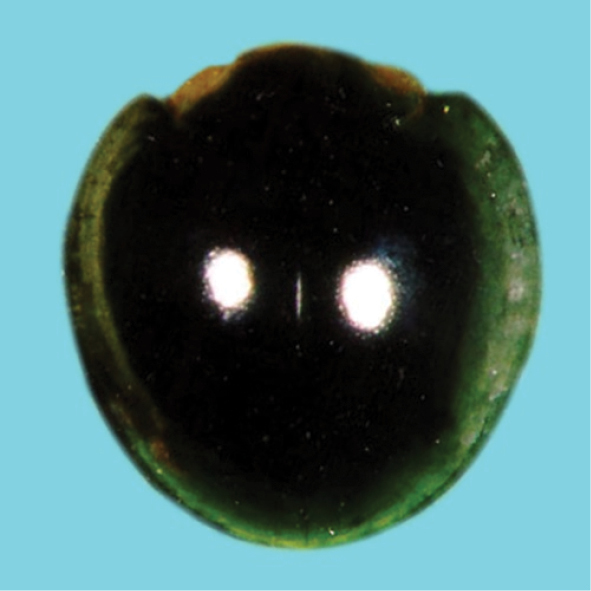
- Picture by Ali M, Ahmed K, Ali S, Raza G, Hussain I, Nafees MA, Anjum SI (2018) An annotated checklist of Coccinellidae with four new records from Pakistan (Coleoptera, Co. CC BY 4.0, Wikimedia Commons. The sticker of this bug is drawn from this picture.
If we got something wrong, sorry, we are bug fans, not a science journal. Tell us at [email protected] and we will fix it.
Bug Wiki honey jar For grown-ups: Bug Wiki is free, with no ads and no tracking. A small tip helps keep it online.Leave a tip Seven-spot ladybird
 Harlequin ladybird
 Mealybug destroyer
 Twenty-two-spot ladybird
 Twice-stabbed ladybird
 Spotted pink ladybird
 Dingy cutworm moth
 American horse fly
 Brown droptail ant
 Rose plume moth
 Bluegrass billbug
 Short-haired bumble bee
_Figure_12.jpg)