
Orange-spined drone fly
Eristalis nemorum

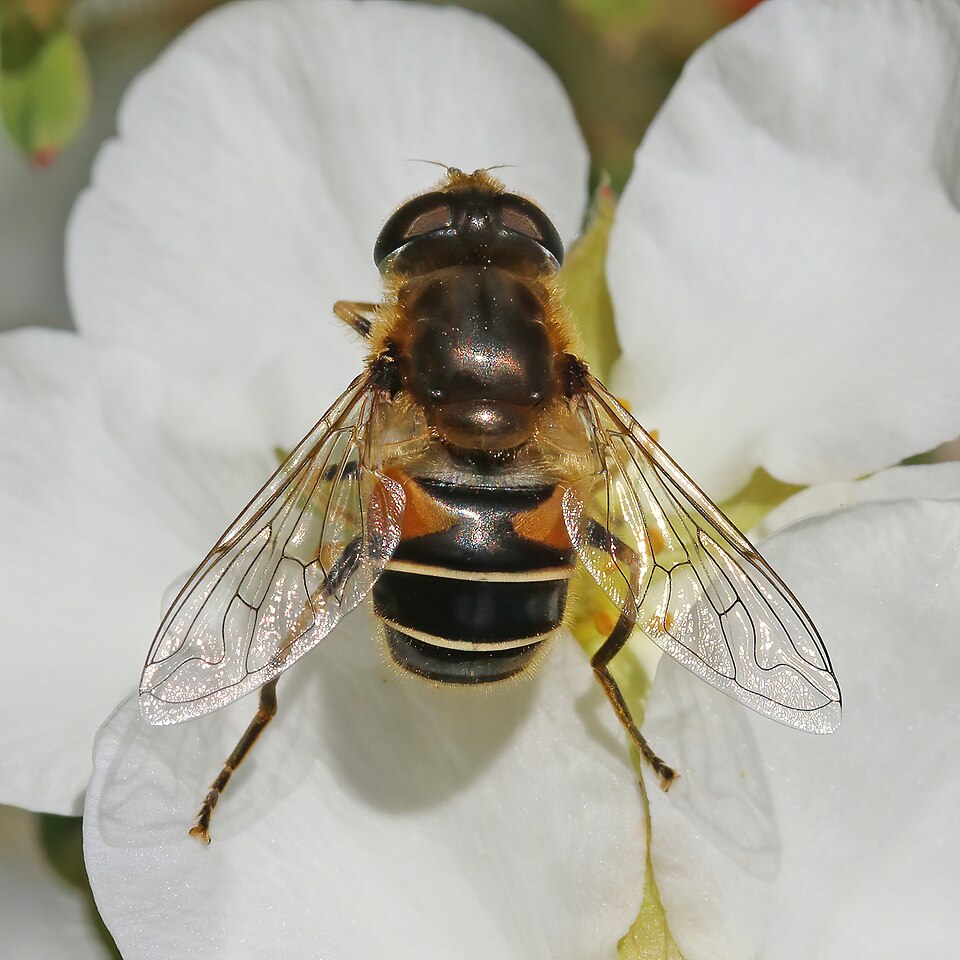
The orange-spined drone fly is a hoverfly covered in yellow hairs. Hoverflies can hang still in the air like tiny helicopters. Its babies grow up in water and breathe through a long tail like a snorkel.
Lives in
Europe, Turkey, Russia, Siberia and Japan, and North America from Quebec to Colorado, by streams and damp meadows
Can it hurt you?
Harmless
Harmless. Hoverflies cannot bite or sting.
What does it eat?
Grown-ups visit lots of flowers, like buttercups, thistles, mint and brambles.
How fast is it?
A person walking about 5 km/h (3.1 mph)
A kid running fast about 13 km/h (8.1 mph)
Orange-spined drone fly about 14 km/h (8.7 mph)
A grown-up on a bike about 25 km/h (16 mph)
cool stuff
Fun facts
1
Its larva is called a rat-tailed maggot because of its long breathing tube.
2
A male hovers above a female for minutes while she feeds, to win her over.
3
When there are many males, two or more may hover over the same female.
4
Each of its wings is about 1 centimetre long.
you asked
Most asked questions about Orange-spined drone fly
?Can the orange-spined drone fly sting?
No. It is a hoverfly and cannot bite or sting.
?Where do drone fly babies live?
In water. They are rat-tailed maggots that breathe through a long tube.
For bug experts
- Scientific name
- Eristalis nemorum
- Group
- Flies and mosquitoes
- Family
- Syrphidae
- Classification
- Insecta > Diptera > Syrphidae
- Lives on
- Europe, Asia, North America
Where the facts come from
- Eristalis nemorum (Wikipedia, CC BY-SA 4.0): what it looks like, where it lives, what it eats, sizes and fun facts, retold in simple words.
- Picture by Charles J. Sharp. CC BY-SA 4.0, Wikimedia Commons. The sticker of this bug is drawn from this picture.
If we got something wrong, sorry, we are bug fans, not a science journal. Tell us at [email protected] and we will fix it.
Bug Wiki honey jar For grown-ups: Bug Wiki is free, with no ads and no tracking. A small tip helps keep it online.Leave a tip Housefly
 New World screwworm fly
 Lovebug
 Tsetse fly
 Common fruit fly
 Asian tiger mosquito
 Ebony jewelwing
 Fen raft spider
 Malaysian trumpet snail
 Raft spider
 Scarlet tiger moth
 Tansy beetle
_female.jpg)