
Black-horned gem fly
Microchrysa polita

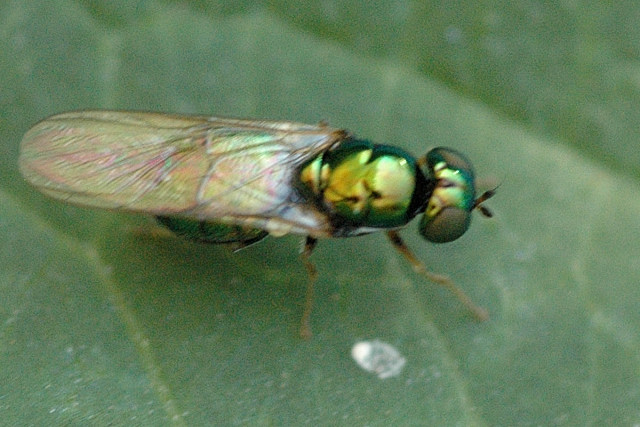
The black-horned gem fly is a tiny soldier fly with black feelers and mostly black legs. It is only about half a centimetre long. You might spot it in gardens, parks and along hedges.
Lives in
Europe, Asia and North America, in gardens, parks, hedges and woodland edges
Length
4.5 to 5.5 mm (0.18 to 0.22 in)
Can it hurt you?
Harmless
Harmless. It cannot bite or sting.
What does it eat?
Its larvae live in soil, rotting grass and leaves, and compost heaps, where they feed on the old plant bits.
How big is it?
How long is it?
💅small enough to sit on your fingernail⚽could fly across a whole football pitch in 57 seconds⚡moves 330 times its own body length every second
How big is Black-horned gem fly compared to YOU?
Just maths in your browser. Nothing is saved or sent anywhere.
How fast is it?
A person walking about 5 km/h (3.1 mph)
Black-horned gem fly about 6.6 km/h (4.1 mph)
A kid running fast about 13 km/h (8.1 mph)
A grown-up on a bike about 25 km/h (16 mph)
cool stuff
Fun facts
1
It flies from March all the way to September.
2
Its babies grow up in compost heaps, so they help turn old leaves back into soil.
3
It lives on three continents, from Western Europe and Russia to the United States and Canada.
you asked
Most asked questions about Black-horned gem fly
?Where can you find a black-horned gem fly?
In gardens, parks, hedges and at the edges of woods.
?Is the black-horned gem fly harmful?
No. It is harmless, and its larvae even help break down compost.
For bug experts
- Scientific name
- Microchrysa polita
- Group
- Flies and mosquitoes
- Family
- Stratiomyidae
- Classification
- Insecta > Diptera > Stratiomyidae
- Lives on
- Europe, Asia, North America
- Also known as
- Black-horned gem
Where the facts come from
- Microchrysa polita (Wikipedia, CC BY-SA 4.0): what it looks like, where it lives, what it eats, sizes and fun facts, retold in simple words.
- Picture by James K. Lindsey. CC BY-SA 3.0, Wikimedia Commons. The sticker of this bug is drawn from this picture.
If we got something wrong, sorry, we are bug fans, not a science journal. Tell us at [email protected] and we will fix it.
Bug Wiki honey jar For grown-ups: Bug Wiki is free, with no ads and no tracking. A small tip helps keep it online.Leave a tip Housefly
 New World screwworm fly
 Lovebug
 Tsetse fly
 Common fruit fly
 Asian tiger mosquito
 Japanese boxer mantis
 Short-tailed blue
 Least carpet
 Lesser wanderer
 Ornamental orbweaver
 Silky field ant