
Common wasp-mimic bee

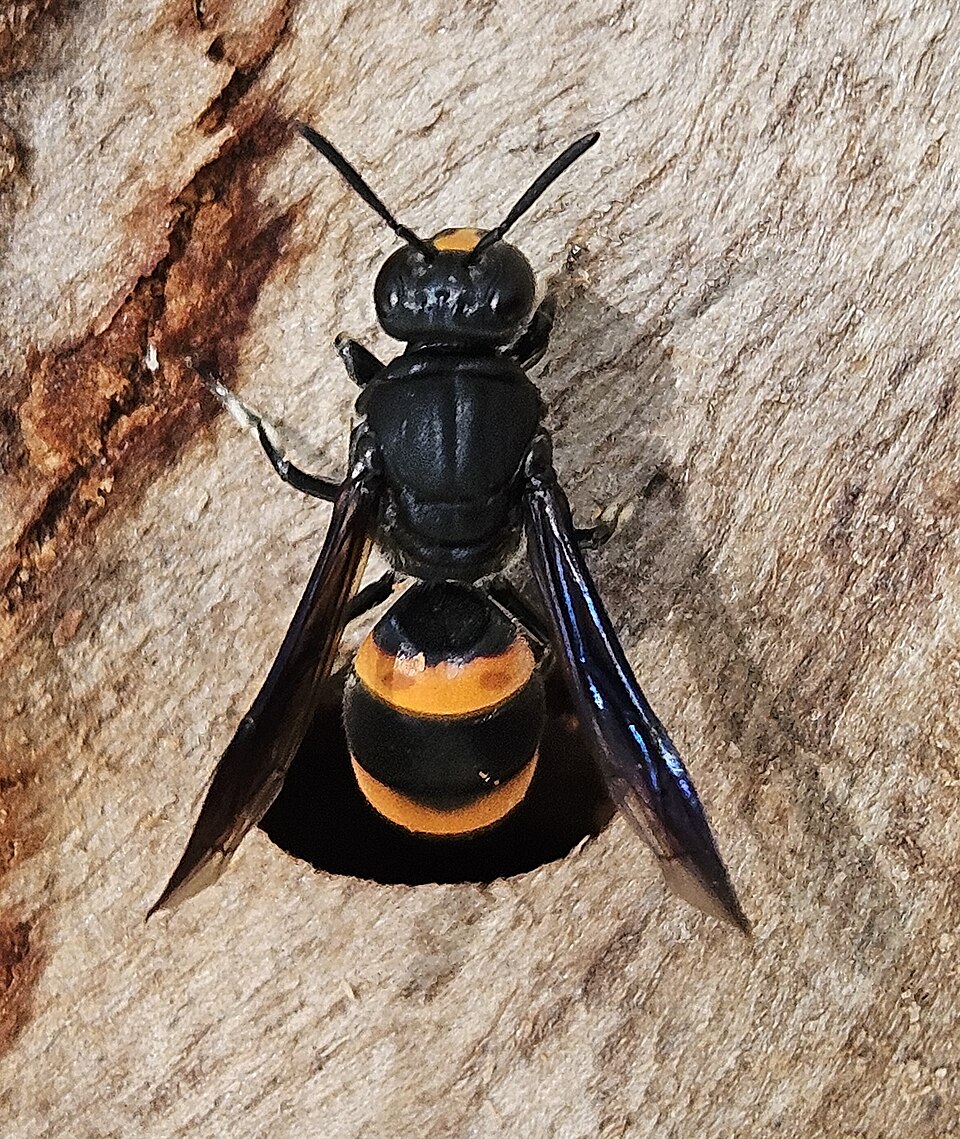
The common wasp-mimic bee is a bee in a wasp costume. Its body is black and orange, and it even holds its wings out in a V like a wasp. The trick probably scares off hungry birds, because wasps are fiercer than bees.
How big is it?
How long is it?
How big is Common wasp-mimic bee compared to YOU?
Just maths in your browser. Nothing is saved or sent anywhere.
How fast is it?
Fun facts
It fooled even the scientist who first named it in 1775. He thought it was a wasp.
The mother hangs a curtain of shiny threads over her nest door and often rests behind it with just her feelers poking out.
It nests in old tunnels in wood, and it is happy to move into a bee hotel too.
It carries pollen inside its body instead of on hairy legs like many other bees.
In 2019 it was on an Australian postage stamp.
Most asked questions about Common wasp-mimic bee
?How can you tell it is a bee and not a wasp?
It moves slowly from flower to flower and has small tufts of fluffy hair on its back.
?Where does the wasp-mimic bee live?
In south-eastern Australia. It also travelled to New Zealand by accident, hidden in wood.
For bug experts
- Scientific name
- Hyleoides concinna
- Named by
- Fabricius, 1775
- Group
- Bees and bumblebees
- Family
- Colletidae
- Classification
- Insecta > Hymenoptera > Colletidae
- Lives on
- Australia and Oceania
Where the facts come from
- Hyleoides concinna (Wikipedia, CC BY-SA 4.0): what it looks like, where it lives, what it eats, sizes and fun facts, retold in simple words.
- Picture by Heath Hunter. CC BY-SA 4.0, Wikimedia Commons. The sticker of this bug is drawn from this picture.
If we got something wrong, sorry, we are bug fans, not a science journal. Tell us at [email protected] and we will fix it.
Bug Wiki honey jar For grown-ups: Bug Wiki is free, with no ads and no tracking. A small tip helps keep it online.Leave a tip Western honey bee
 Buff-tailed bumblebee
 Violet carpenter bee
 Giant honey bee
 Wallace's giant bee
 Himalayan giant honey bee
 Scooped scarab
 Bramble sawfly
 Toltec scoliid wasp
 Redcurrant blister aphid
 Balkan marbled white
 Cold weather mosquito