
Twin-spot centurion fly

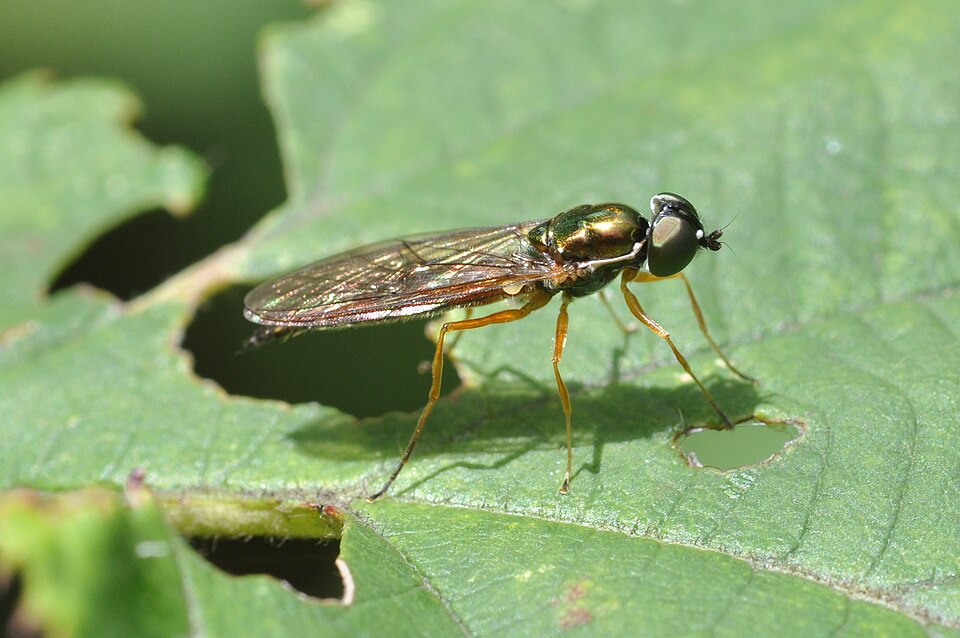
The twin-spot centurion fly is a shiny soldier fly with a metallic green back and a brown tummy with a purple shine. It has red legs and slightly yellow wings. It likes to sunbathe on leaves in sheltered, sunny spots.
How big is it?
How long is it?
How big is Twin-spot centurion fly compared to YOU?
Just maths in your browser. Nothing is saved or sent anywhere.
How fast is it?
Fun facts
Females lay their eggs on fresh dung or in the soil right next to it.
It flies late in the year, from July to November.
Females are broader than the slim males and have a reddish tummy with a blackish, blue-shining tip.
Its larvae have even been found inside the egg pods of locusts.
Most asked questions about Twin-spot centurion fly
?Is the twin-spot centurion dangerous?
No. It is a harmless fly that cannot bite or sting.
?What does the twin-spot centurion eat?
Its larvae eat dung, compost and rotting plants, which helps recycle them.
For bug experts
- Scientific name
- Sargus bipunctatus
- Group
- Flies and mosquitoes
- Family
- Stratiomyidae
- Classification
- Insecta > Diptera > Stratiomyidae
- Lives on
- Europe, Asia
- Also known as
- Twin-spot centurion
Where the facts come from
- Sargus bipunctatus (Wikipedia, CC BY-SA 4.0): what it looks like, where it lives, what it eats, sizes and fun facts, retold in simple words.
- Picture by Aiwok. CC BY-SA 3.0, Wikimedia Commons. The sticker of this bug is drawn from this picture.
If we got something wrong, sorry, we are bug fans, not a science journal. Tell us at [email protected] and we will fix it.
Bug Wiki honey jar For grown-ups: Bug Wiki is free, with no ads and no tracking. A small tip helps keep it online.Leave a tip Housefly
 New World screwworm fly
 Lovebug
 Tsetse fly
 Common fruit fly
 Asian tiger mosquito
 The clay
 Northern checkerspot
 Knapweed root moth
 Field crescent
 Coprosma hawk moth
 Small grass-yellow