
Tulip-tree silkmoth

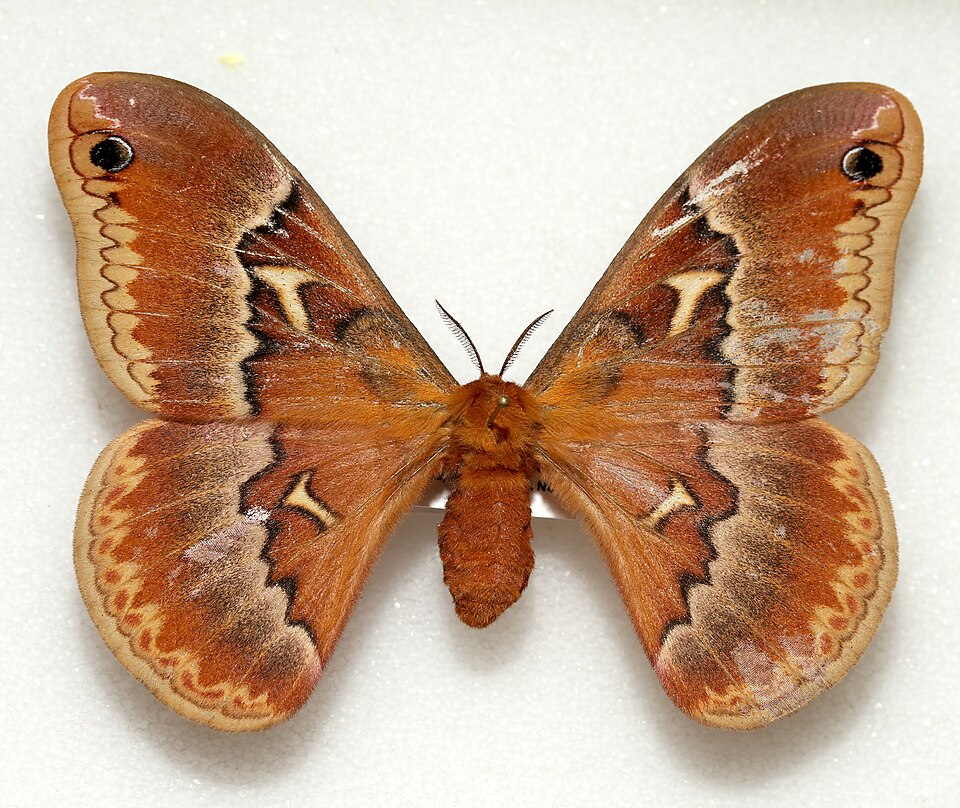
The tulip-tree silkmoth is a big, beautiful silk moth from North America. Its wings can be wider than a grown-up's hand. Its caterpillar is a fussy eater that only eats the leaves of the tulip tree.
How big is it?
How wide are its wings?
How big is Tulip-tree silkmoth compared to YOU?
Just maths in your browser. Nothing is saved or sent anywhere.
How fast is it?
Fun facts
The grown-up moth never eats, so it lives only on the energy it stored as a caterpillar.
In the north it has one family a year, flying from June to August.
In the south it has two families a year, flying in spring and again in August.
Most asked questions about Tulip-tree silkmoth
?What does the tulip-tree silkmoth eat?
Only its caterpillar eats, and only tulip tree leaves. The adult moth does not eat at all.
?How big is the tulip-tree silkmoth?
Its wings measure about 8 to 11 centimetres from tip to tip.
For bug experts
- Scientific name
- Callosamia angulifera
- Named by
- Walker, 1855
- Group
- Moths
- Family
- Saturniidae
- Classification
- Insecta > Lepidoptera > Saturniidae
- Lives on
- North America
- Also known as
- Tuliptree silkmoth, Giant silkmoth
Where the facts come from
- Callosamia angulifera (Wikipedia, CC BY-SA 4.0): what it looks like, where it lives, what it eats, sizes and fun facts, retold in simple words.
- Picture by NCBioTeacher. CC0, Wikimedia Commons. The sticker of this bug is drawn from this picture.
If we got something wrong, sorry, we are bug fans, not a science journal. Tell us at [email protected] and we will fix it.
Bug Wiki honey jar For grown-ups: Bug Wiki is free, with no ads and no tracking. A small tip helps keep it online.Leave a tip Atlas moth
 Luna moth
 Hummingbird hawk-moth
 Domestic silk moth
 Isabella tiger moth
 Polyphemus moth
 European spruce bark beetle
 Blue ghost firefly
 Giant Asian mantis
 Broad-necked root borer
 Great capricorn beetle
 Red-femured spotted orbweaver