
Death head bug
Eucorysses grandis

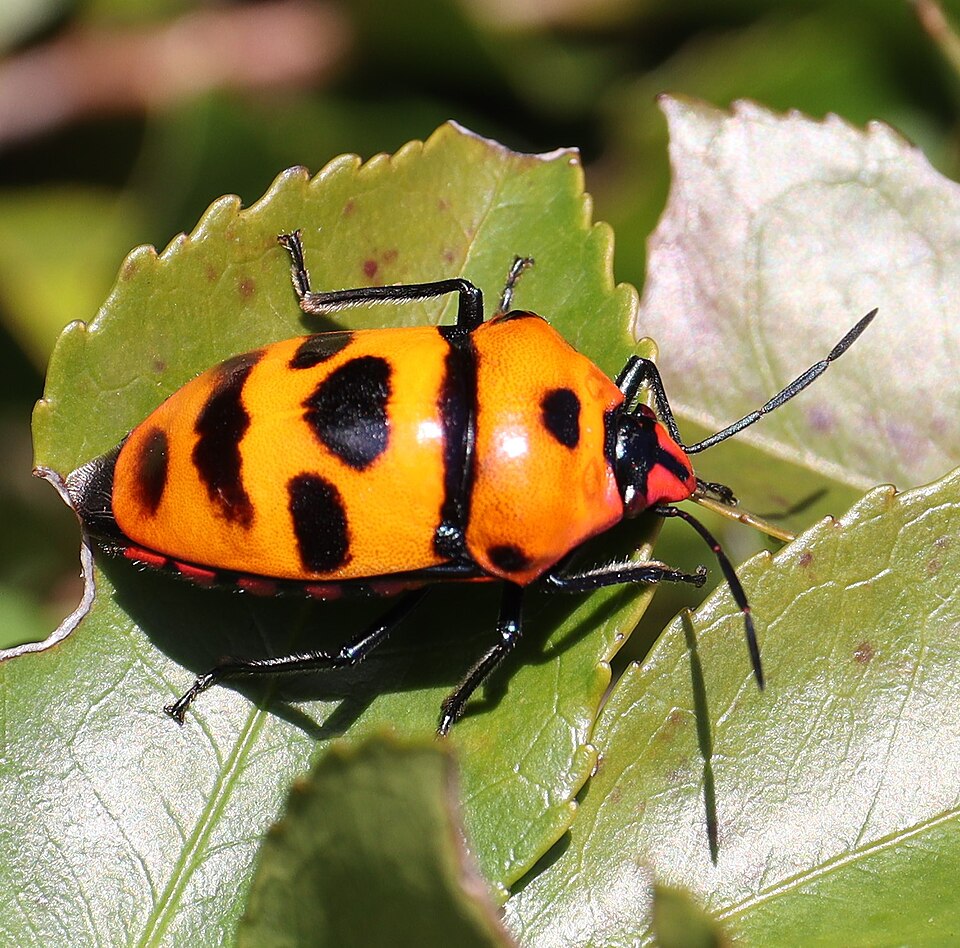
The death head bug is a colourful shield bug from Asia. It can be cream, orange or purplish red, with black spots and a bluish shine. Its back is covered by one big shield, like a little knight's armour.
Lives in
Asia, from India, China and Japan down to the islands of Southeast Asia
Can it hurt you?
Harmless
Harmless to people. Just watch it and let it walk on.
What does it eat?
Like other shield-backed bugs, it sucks juice from plants with its long, thin beak.
How fast is it?
A garden snail about 0.05 km/h (0.03 mph)
Death head bug about 0.2 km/h (0.12 mph)
A tortoise about 0.3 km/h (0.19 mph)
A person walking about 5 km/h (3.1 mph)
cool stuff
Fun facts
1
Not every death head bug looks the same. Some are cream, some are orange and some are purplish red.
2
Its black spots and bluish shine can make it look like it is painted.
3
It belongs to the shield-backed bugs, whose big back shield covers almost the whole body.
you asked
Most asked questions about Death head bug
?Is the death head bug dangerous?
No. Despite its spooky name, it is a harmless plant-eating bug.
?Where does the death head bug live?
In Asia, in India, China, Japan and on the islands of Southeast Asia.
For bug experts
- Scientific name
- Eucorysses grandis
- Group
- True bugs and cicadas
- Family
- Scutelleridae
- Classification
- Insecta > Hemiptera > Scutelleridae
- Lives on
- Asia
Where the facts come from
- Eucorysses grandis (Wikipedia, CC BY-SA 4.0): what it looks like, where it lives, what it eats, sizes and fun facts, retold in simple words.
- Picture by Alpsdake. CC BY-SA 4.0, Wikimedia Commons. The sticker of this bug is drawn from this picture.
If we got something wrong, sorry, we are bug fans, not a science journal. Tell us at [email protected] and we will fix it.
Bug Wiki honey jar For grown-ups: Bug Wiki is free, with no ads and no tracking. A small tip helps keep it online.Leave a tip Pharaoh cicada
 Spotted lanternfly
 Brown marmorated stink bug
 Cochineal
 Boxelder bug
 Western conifer seed bug
 Golden stag beetle
 Knopper gall wasp
 Large tolype moth
 New Zealand giraffe weevil
 Yellow-vented hornet
 Pacific dampwood termite