
Oak lace bug
Corythucha arcuata

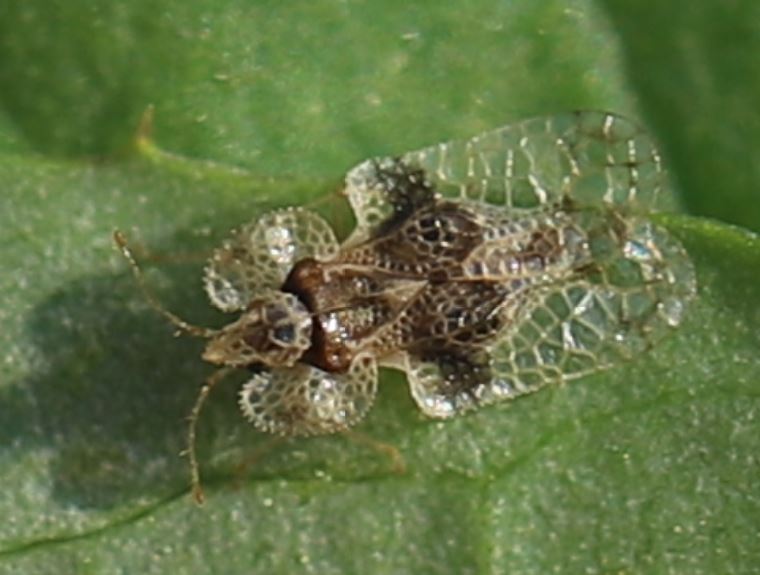
The oak lace bug is a very small bug with see-through wings that look like fine lace. It lives on oak leaves. It came from America and has now spread to many countries in Europe.
Lives in
North America, and since 2000 also more than 20 countries in Europe, on oaks
Can it hurt you?
Harmless
Harmless. It cannot bite or sting people, so you can watch it up close.
What does it eat?
It feeds on oak leaves, and big groups of them can harm the trees.
How fast is it?
A garden snail about 0.05 km/h (0.03 mph)
Oak lace bug about 0.2 km/h (0.12 mph)
A tortoise about 0.3 km/h (0.19 mph)
A person walking about 5 km/h (3.1 mph)
cool stuff
Fun facts
1
It spends the winter as a grown-up bug, hiding until spring.
2
It was first seen in Europe in the year 2000. Ten years later it started to spread very fast.
3
In parts of the United States it has three generations every year.
4
In Europe it has no known enemies yet, which is one reason it spreads so easily.
you asked
Most asked questions about Oak lace bug
?Is the oak lace bug harmful?
It is harmless to people, but large numbers can damage oak trees.
?Where does the oak lace bug come from?
From North America. It arrived in Europe in 2000.
For bug experts
- Scientific name
- Corythucha arcuata
- Group
- True bugs and cicadas
- Family
- Tingidae
- Classification
- Insecta > Hemiptera > Tingidae
- Lives on
- North America, Europe
Where the facts come from
- Corythucha arcuata (Wikipedia, CC BY-SA 4.0): what it looks like, where it lives, what it eats, sizes and fun facts, retold in simple words.
- Picture by Slimguy. CC BY 4.0, Wikimedia Commons. The sticker of this bug is drawn from this picture.
If we got something wrong, sorry, we are bug fans, not a science journal. Tell us at [email protected] and we will fix it.
Bug Wiki honey jar For grown-ups: Bug Wiki is free, with no ads and no tracking. A small tip helps keep it online.Leave a tip Pharaoh cicada
 Spotted lanternfly
 Brown marmorated stink bug
 Cochineal
 Boxelder bug
 Western conifer seed bug
 Cardinal butterfly
 Pine-tree lappet
 Inchman ant
 Willow clytra
 Lapland bumble bee
 California gall wasp