
Green-eyed flower bee
Anthophora bimaculata
Name means: “two-spotted, from the Latin words for two and spotted”

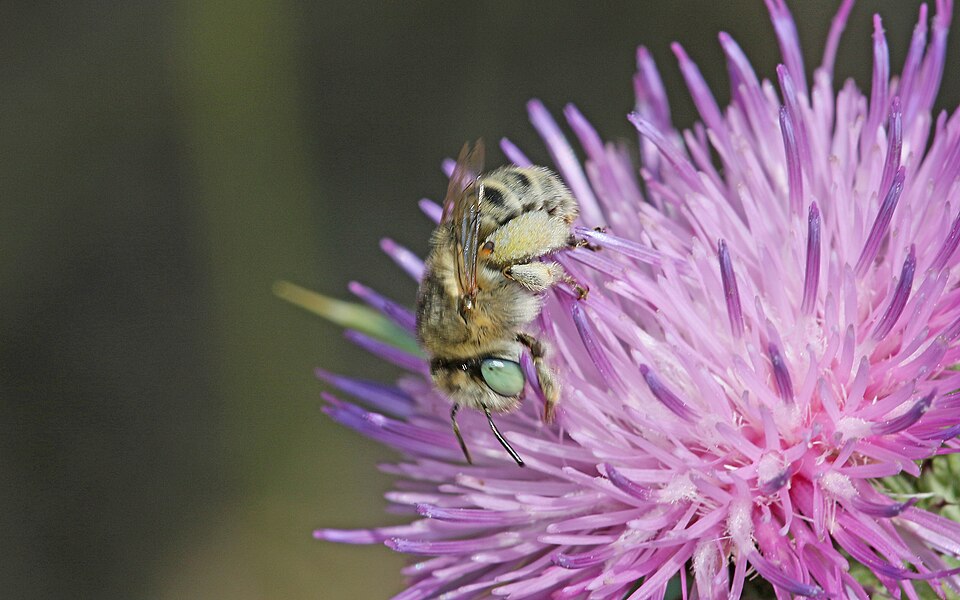
The green-eyed flower bee is a small, hairy bee with olive green eyes. It zooms from flower to flower with a very high buzzing sound. It digs its nest in sand.
Lives in
Europe, North Africa and Asia as far as Siberia, in sandy places
Length
8 to 9 mm (0.31 to 0.35 in)
What does it eat?
It drinks nectar and collects pollen from many kinds of flowers, like knapweed, viper's bugloss and purple loosestrife.
How big is it?
How long is it?
💅small enough to sit on your fingernail🍚as long as 1.5 grains of rice in a row⚽could fly across a whole football pitch in 20 seconds⚡moves 590 times its own body length every second
How big is Green-eyed flower bee compared to YOU?
Just maths in your browser. Nothing is saved or sent anywhere.
How fast is it?
A kid running fast about 13 km/h (8.1 mph)
Green-eyed flower bee about 19 km/h (12 mph)
A grown-up on a bike about 25 km/h (16 mph)
A car driving in town about 50 km/h (31 mph)
cool stuff
Fun facts
1
It only nests in fine sand, for example in sand dunes, sandpits and sandy banks.
2
Its nest tunnel goes about 4 to 5 centimetres into the ground.
3
Cuckoo bees sometimes sneak into its nest and leave their own eggs there.
4
Sometimes many of them nest close together in one sandy spot.
you asked
Most asked questions about Green-eyed flower bee
?Why is it called the green-eyed flower bee?
Both the males and the females have olive green eyes.
?Where does the green-eyed flower bee live?
In Europe, North Africa and Asia, in sandy places like dunes and sandpits.
For bug experts
- Scientific name
- Anthophora bimaculata
- Named by
- Panzer, 1798
- Group
- Bees and bumblebees
- Family
- Apidae
- Classification
- Insecta > Hymenoptera > Apidae
- Lives on
- Europe, Africa, Asia
Where the facts come from
- Anthophora bimaculata (Wikipedia, CC BY-SA 4.0): what it looks like, where it lives, what it eats, sizes and fun facts, retold in simple words.
- Picture by ChrisMoWiki. CC BY-SA 4.0, Wikimedia Commons. The sticker of this bug is drawn from this picture.
If we got something wrong, sorry, we are bug fans, not a science journal. Tell us at [email protected] and we will fix it.
Bug Wiki honey jar For grown-ups: Bug Wiki is free, with no ads and no tracking. A small tip helps keep it online.Leave a tip Western honey bee
 Buff-tailed bumblebee
 Violet carpenter bee
 Giant honey bee
 Wallace's giant bee
 Himalayan giant honey bee
 Big sand tiger beetle
 Behr's metalmark
 Daffodil leaf-beetle
 White checkered-skipper
 Portland ribbon wave
 Sooty longwing