
Larger elm leaf beetle
Monocesta coryli
Name means: “Its scientific name coryli means of the hazel, even though it mostly eats elm.”

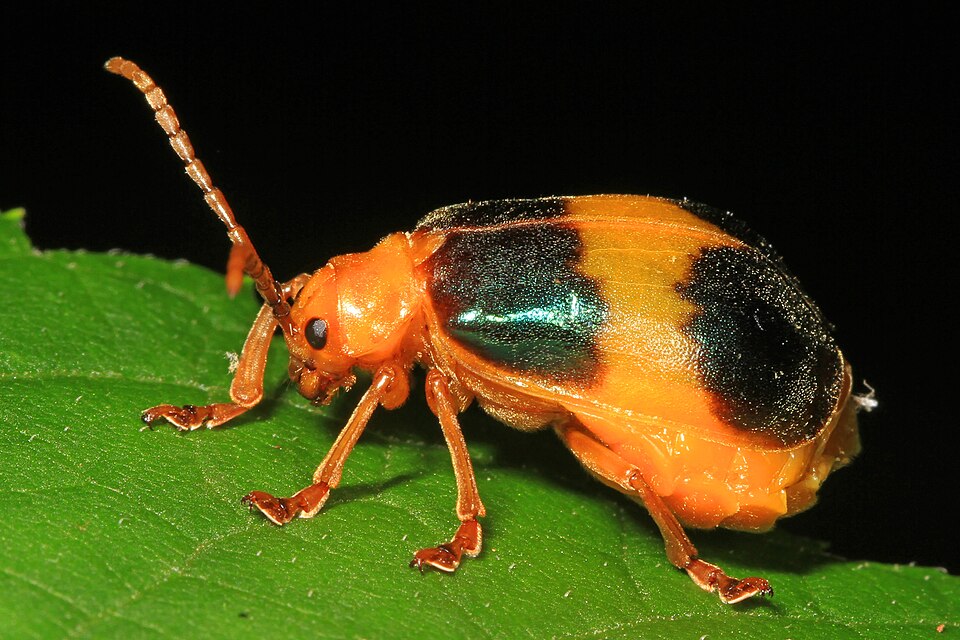
The larger elm leaf beetle is a fairly big orange leaf beetle with shiny blue-green spots. Some have brown spots or no spots at all. It lives mostly on elm trees in North America.
Lives in
Eastern and southeastern North America, from Florida to Kansas and Pennsylvania
Length
1 to 1.6 cm (0.39 to 0.63 in)
Can it hurt you?
Harmless
Harmless. It cannot bite or sting people.
What does it eat?
It eats elm leaves and sometimes hazel leaves, leaving just the thin veins behind like a skeleton.
How big is it?
How long is it?
🍚as long as 2.5 grains of rice in a row🍽️could run across a dinner table in 6.9 seconds
How big is Larger elm leaf beetle compared to YOU?
Just maths in your browser. Nothing is saved or sent anywhere.
How fast is it?
A garden snail about 0.05 km/h (0.03 mph)
A tortoise about 0.3 km/h (0.19 mph)
Larger elm leaf beetle about 0.52 km/h (0.32 mph)
A person walking about 5 km/h (3.1 mph)
cool stuff
Fun facts
1
It is the only member of its big tropical group, Monocesta, that lives in the United States.
2
It skeletonizes leaves, eating the soft parts and leaving a lacy net of veins.
3
Its scientific name coryli refers to hazels, even though it mostly eats elm.
you asked
Most asked questions about Larger elm leaf beetle
?What does the larger elm leaf beetle eat?
Mostly elm leaves, and sometimes hazel leaves.
?What does the larger elm leaf beetle look like?
It is orange with metallic blue-green spots and 1 to 1.6 centimetres long.
For bug experts
- Scientific name
- Monocesta coryli
- Group
- Beetles
- Family
- Chrysomelidae
- Classification
- Insecta > Coleoptera > Chrysomelidae
- Lives on
- North America
Where the facts come from
- Monocesta coryli (Wikipedia, CC BY-SA 4.0): what it looks like, where it lives, what it eats, sizes and fun facts, retold in simple words.
- Picture by Judy Gallagher. CC BY 2.0, Wikimedia Commons. The sticker of this bug is drawn from this picture.
If we got something wrong, sorry, we are bug fans, not a science journal. Tell us at [email protected] and we will fix it.
Bug Wiki honey jar For grown-ups: Bug Wiki is free, with no ads and no tracking. A small tip helps keep it online.Leave a tip Stag beetle
 Hercules beetle
 Common glow-worm
 Goliath beetle
 Cockchafer
 Mealworm beetle
 Imperial jezebel
 Early thorn
 Woodland malaria mosquito
 Great oak beauty
 Oak leafshredder moth
 Red-green carpet