
Pale brindled beauty
Phigalia pilosaria

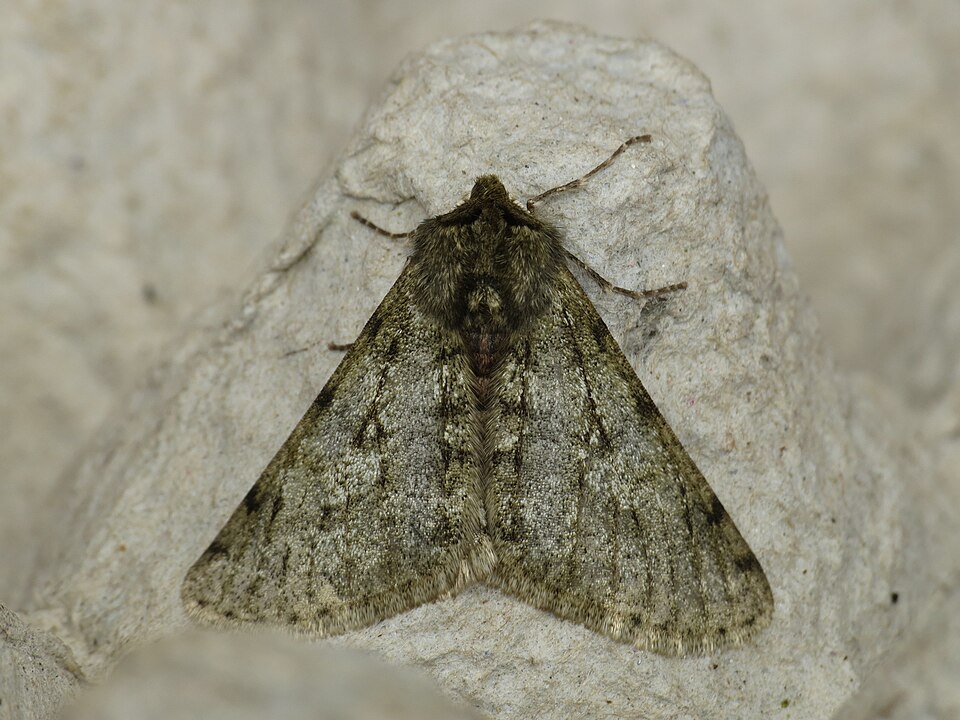
The pale brindled beauty is a grey moth that flies in late winter and early spring, when most insects are still asleep. Only the males can fly. The females have no wings at all and crawl up tree trunks.
Lives in
From Europe and Turkey to the Caucasus, in woods with leafy trees
Wingspan
3.5 to 4 cm (1.4 to 1.6 in)
males only, females have no wingsCan it hurt you?
Harmless
Harmless. It does not bite or sting.
What does it eat?
Its caterpillars eat the leaves of many trees, like oak.
How big is it?
How wide are its wings?
🍚wings as wide as 7 grains of rice in a row⚽could fly across a whole football pitch in 27 seconds
How big is Pale brindled beauty compared to YOU?
Just maths in your browser. Nothing is saved or sent anywhere.
How fast is it?
A person walking about 5 km/h (3.1 mph)
A kid running fast about 13 km/h (8.1 mph)
Pale brindled beauty about 14 km/h (8.7 mph)
A grown-up on a bike about 25 km/h (16 mph)
cool stuff
Fun facts
1
It flies from January to April, even on cold nights.
2
Some males are almost completely black.
3
Its caterpillar is brown with rusty patches, a good disguise on a twig.
4
It has just one family of young each year.
you asked
Most asked questions about Pale brindled beauty
?Can the female pale brindled beauty fly?
No. The female has no wings. Only the male flies.
?When can you see the pale brindled beauty?
From January to April, in late winter and early spring.
For bug experts
- Scientific name
- Phigalia pilosaria
- Named by
- Denis & Schiffermüller, 1775
- Group
- Moths
- Family
- Geometridae
- Classification
- Insecta > Lepidoptera > Geometridae
- Lives on
- Europe, Asia
Where the facts come from
- Phigalia pilosaria (Wikipedia, CC BY-SA 4.0): what it looks like, where it lives, what it eats, sizes and fun facts, retold in simple words.
- Picture by Donald Hobern from Copenhagen, Denmark. CC BY 2.0, Wikimedia Commons. The sticker of this bug is drawn from this picture.
If we got something wrong, sorry, we are bug fans, not a science journal. Tell us at [email protected] and we will fix it.
Bug Wiki honey jar For grown-ups: Bug Wiki is free, with no ads and no tracking. A small tip helps keep it online.Leave a tip Atlas moth
 Luna moth
 Hummingbird hawk-moth
 Domestic silk moth
 Isabella tiger moth
 Polyphemus moth
 Forest scorpion
 Black-tailed hornet
 Snow fly
 Pink-edged sulphur
 Greene's giant ichneumonid wasp
 Sculptured pine borer
.jpg)