
Western corsair bug

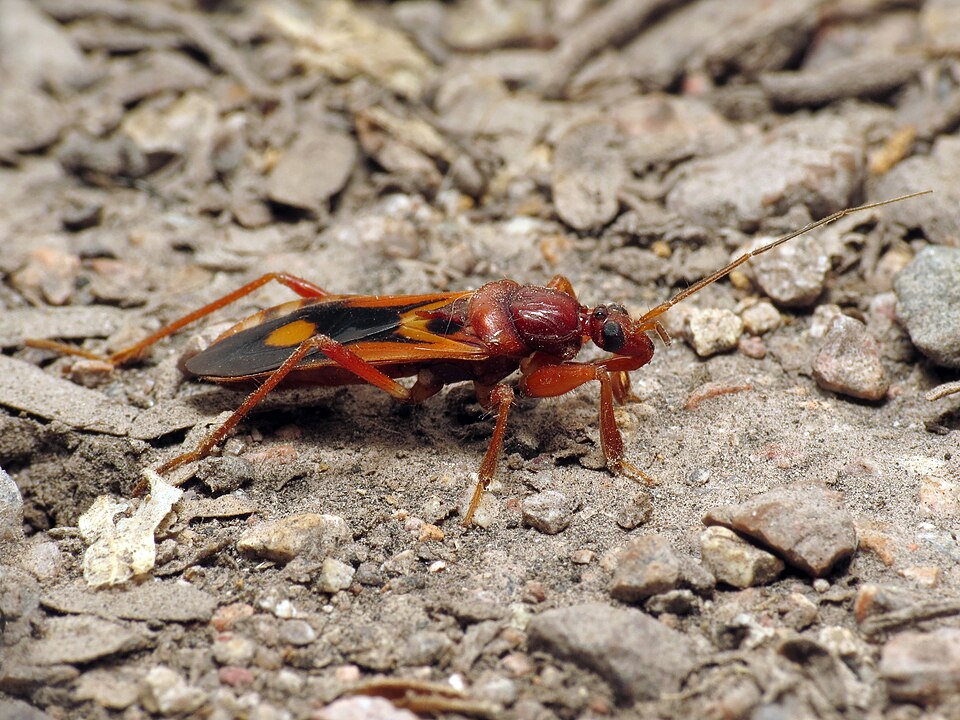
The western corsair is an orange and black assassin bug with long, shiny legs. Each wing has one big orange or red spot, and when the wings are folded the two spots look like one. It hunts other insects at night.
How big is it?
How long is it?
How big is Western corsair bug compared to YOU?
Just maths in your browser. Nothing is saved or sent anywhere.
How fast is it?
Fun facts
Its front legs are bigger than the others, which helps it hold on to prey.
At night it flies to bright lights, because lots of insects gather there to eat.
The sides of its tummy have a black and yellow checkered pattern.
Its bite does not spread Chagas disease. That is spread by some of its cousins, not by the corsair.
Its babies grow up in five steps and turn straight into winged adults, with no cocoon stage.
Most asked questions about Western corsair bug
?Is the western corsair dangerous?
Its bite is very painful, but it only bites when handled roughly. If you leave it alone, it leaves you alone.
?What does the western corsair eat?
Other insects, like caterpillars, beetle larvae, bees and even ladybirds.
?When can you see a western corsair?
Mostly on summer and autumn evenings, from July to October, often near lights.
For bug experts
- Scientific name
- Rasahus thoracicus
- Group
- True bugs and cicadas
- Family
- Reduviidae
- Classification
- Insecta > Hemiptera > Reduviidae
- Lives on
- North America
- Also known as
- Western corsair, Two-spotted corsair
Where the facts come from
- Western corsair (Wikipedia, CC BY-SA 4.0): what it looks like, where it lives, what it eats, sizes and fun facts, retold in simple words.
- Picture by Katja Schulz. CC BY 2.0, Wikimedia Commons. The sticker of this bug is drawn from this picture.
If we got something wrong, sorry, we are bug fans, not a science journal. Tell us at [email protected] and we will fix it.
Bug Wiki honey jar For grown-ups: Bug Wiki is free, with no ads and no tracking. A small tip helps keep it online.Leave a tip Pharaoh cicada
 Spotted lanternfly
 Brown marmorated stink bug
 Cochineal
 Boxelder bug
 Western conifer seed bug
 Baja California bark scorpion
 Egyptian giant camel spider
 Thistledown velvet ant
 Grayling butterfly
 Pallid-winged grasshopper
 Flat rock scorpion