
Palemouth

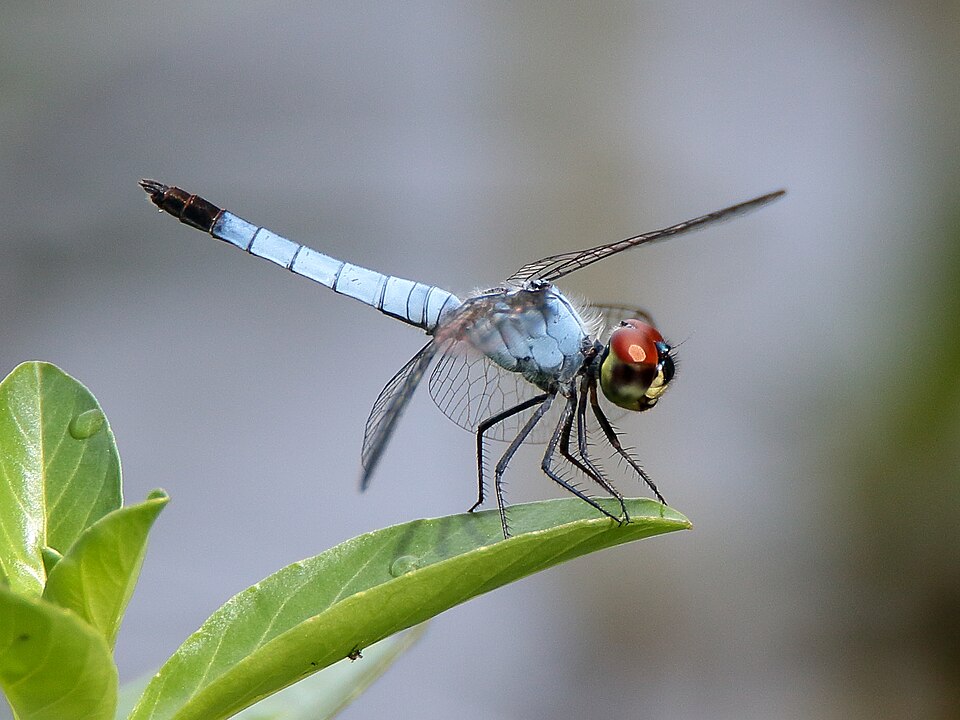
The palemouth is a small dragonfly. The male is bright powder blue all over its body, and it has a pale cream upper lip. That pale mouth is how it got its name.
How big is it?
How wide are its wings?
How big is Palemouth compared to YOU?
Just maths in your browser. Nothing is saved or sent anywhere.
How fast is it?
Fun facts
Its wings measure 40 to 60 millimetres from tip to tip.
Even though the male is bright blue, people often stop seeing it once it lands on a lily pad.
Its scientific name denticauda means toothed tail, because the male has tiny teeth on the tip of its tail.
In northern Australia it lives along the coast in a long curve from Queensland to Broome.
Most asked questions about Palemouth
?Why is it called the palemouth?
Because its upper lip is a pale cream colour.
?How big is the palemouth?
It is a small dragonfly. Its wingspan is about 4 to 6 centimetres.
?Is the palemouth dangerous?
No. Dragonflies have no sting and it is harmless to people.
For bug experts
- Scientific name
- Brachydiplax denticauda
- Group
- Dragonflies and damselflies
- Family
- Libellulidae
- Classification
- Insecta > Odonata > Libellulidae
- Lives on
- Australia and Oceania, Asia
Where the facts come from
- Brachydiplax denticauda (Wikipedia, CC BY-SA 4.0): what it looks like, where it lives, what it eats, sizes and fun facts, retold in simple words.
- Picture by G. Winterflood. CC BY-SA 4.0, Wikimedia Commons. The sticker of this bug is drawn from this picture.
If we got something wrong, sorry, we are bug fans, not a science journal. Tell us at [email protected] and we will fix it.
Bug Wiki honey jar For grown-ups: Bug Wiki is free, with no ads and no tracking. A small tip helps keep it online.Leave a tip Emperor dragonfly
 Common whitetail
 Green darner
 Ebony jewelwing
 Globe skimmer
 Blue dasher
 Dune robber fly
 Hairy-necked tiger beetle
 Willow redgall sawfly
 Lesser silver water beetle
 Orange-striped stonefly
 Freija fritillary