
Woodlouse ant

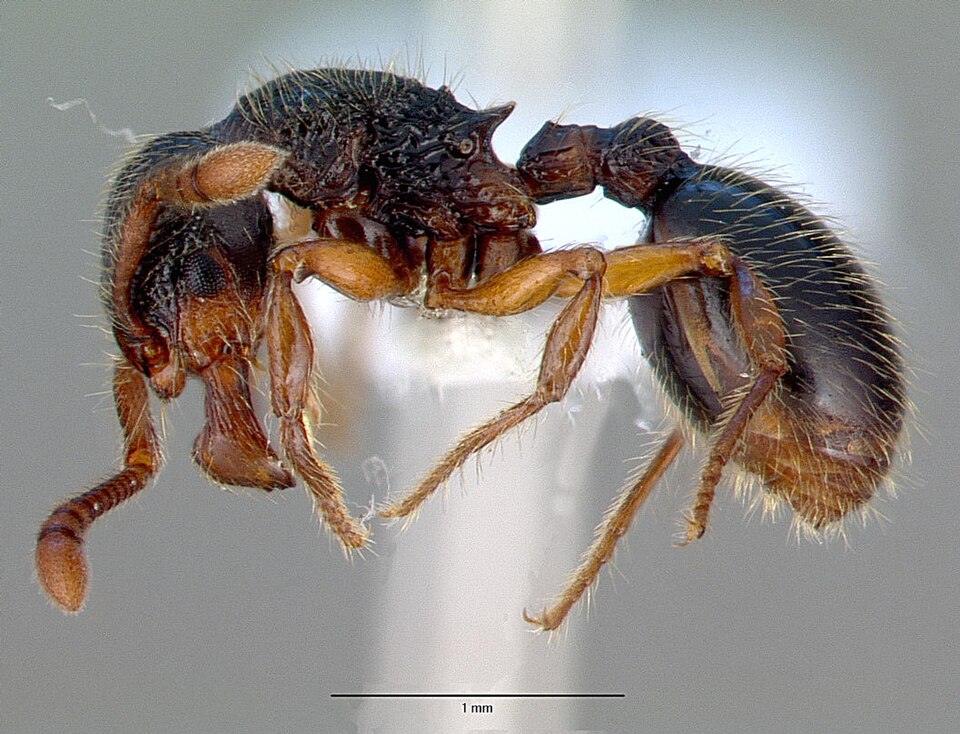
The woodlouse ant is a small, calm ant that lives in tiny families. It makes its nest in the soil, under stones or among fallen leaves. When something scary comes along, it does not fight. It pretends to be dead instead.
How fast is it?
Fun facts
To play dead, it folds in its legs and feelers and lies still.
A colony has only one queen and fewer than 100 workers. Many other ants live in much bigger families.
When the colony moves house, the ants follow the smell trail that the queen leaves behind.
The males fly surprisingly high, 5 to 20 metres above the ground, to find a mate.
When it was first described in 1802, it was put in a different group of ants called Formica.
Most asked questions about Woodlouse ant
?Where does the woodlouse ant live?
In Europe, North Africa and Asia, in nests in soil, under stones and in fallen leaves.
For bug experts
- Scientific name
- Myrmecina graminicola
- Named by
- Latreille, 1802
- Group
- Ants
- Family
- Formicidae
- Classification
- Insecta > Hymenoptera > Formicidae
- Lives on
- Europe, Africa, Asia
Where the facts come from
- Myrmecina graminicola (Wikipedia, CC BY-SA 4.0): what it looks like, where it lives, what it eats, sizes and fun facts, retold in simple words.
- Picture by AntWeb.org. CC BY 4.0, Wikimedia Commons. The sticker of this bug is drawn from this picture.
If we got something wrong, sorry, we are bug fans, not a science journal. Tell us at [email protected] and we will fix it.
Bug Wiki honey jar For grown-ups: Bug Wiki is free, with no ads and no tracking. A small tip helps keep it online.Leave a tip Black garden ant
 Bullet ant
 Pharaoh ant
 Argentine ant
 Red imported fire ant
 Yellow crazy ant
 Cabbage tree moth
 Nosy pill woodlouse
 Long-tailed skipper
 New Zealand mantis
 Western giant swallowtail
 Tree wasp