
Orange-spotted scaphidium
Scaphidium quadrimaculatum

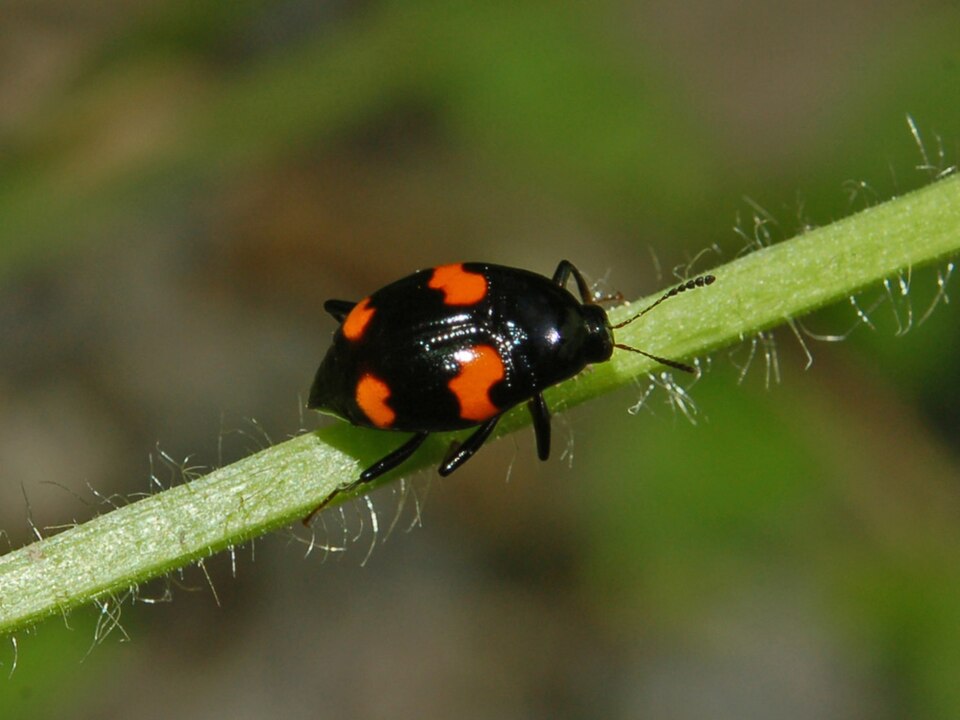
The orange-spotted scaphidium is a tiny, shiny black beetle with a round, oval body. On its back it has four red spots, two on each wing case. It looks a bit like a ladybird with its colours swapped.
Lives in
Most of Europe, North Africa and the Near East, in woods with fungi
Length
5 to 6 mm (0.2 to 0.24 in)
Can it hurt you?
Harmless
Harmless. It is a tiny beetle that cannot hurt you.
What does it eat?
It eats mushrooms and other fungi, especially the hard bracket fungi that grow like shelves on tree trunks.
How big is it?
How long is it?
💅small enough to sit on your fingernail🍽️could run across a dinner table in 11 seconds
How big is Orange-spotted scaphidium compared to YOU?
Just maths in your browser. Nothing is saved or sent anywhere.
How fast is it?
A garden snail about 0.05 km/h (0.03 mph)
A tortoise about 0.3 km/h (0.19 mph)
Orange-spotted scaphidium about 0.32 km/h (0.2 mph)
A person walking about 5 km/h (3.1 mph)
cool stuff
Fun facts
1
It is only about half a centimetre long, about as big as a grain of rice.
2
It is quite rare, so finding one is a lucky moment.
3
You can meet the grown-up beetles from April to August, sitting on fungi.
you asked
Most asked questions about Orange-spotted scaphidium
?What does the orange-spotted scaphidium eat?
Fungi, especially bracket fungi that grow on trees.
?Is the orange-spotted scaphidium a ladybird?
No. It looks a little like one, but it is a different kind of beetle that eats fungi.
For bug experts
- Scientific name
- Scaphidium quadrimaculatum
- Group
- Beetles
- Family
- Staphylinidae
- Classification
- Insecta > Coleoptera > Staphylinidae
- Lives on
- Europe, Africa, Asia
- Also known as
- Shining fungus beetle
Where the facts come from
- Scaphidium quadrimaculatum (Wikipedia, CC BY-SA 4.0): what it looks like, where it lives, what it eats, sizes and fun facts, retold in simple words.
- Picture by Hectonichus. CC BY-SA 3.0, Wikimedia Commons. The sticker of this bug is drawn from this picture.
If we got something wrong, sorry, we are bug fans, not a science journal. Tell us at [email protected] and we will fix it.
Bug Wiki honey jar For grown-ups: Bug Wiki is free, with no ads and no tracking. A small tip helps keep it online.Leave a tip Stag beetle
 Hercules beetle
 Common glow-worm
 Goliath beetle
 Cockchafer
 Mealworm beetle
 Orion cecropian
 Dreamy duskywing
 White M hairstreak
 Scarlet-winged lichen moth
 Imperial jezebel
 Early thorn