
Twin-mark comb-horn
Dictenidia bimaculata

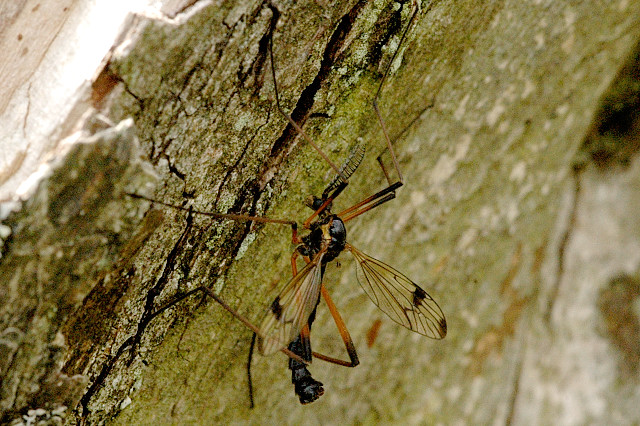
The twin-mark comb-horn is a shiny black crane fly with orange marks. Each wing has two big dark brown spots. The male has feelers with long side branches, like a little comb.
Lives in
Europe and Asia, in damp woods
Can it hurt you?
Harmless
Harmless. Crane flies cannot bite or sting.
What does it eat?
Its babies grow up inside old, rotting wood. The grown-ups live only a short time.
How fast is it?
A person walking about 5 km/h (3.1 mph)
Twin-mark comb-horn about 5 km/h (3.1 mph)
A kid running fast about 13 km/h (8.1 mph)
A grown-up on a bike about 25 km/h (16 mph)
cool stuff
Fun facts
1
Each of its wings is 10 to 15 millimetres long.
2
The female has plain, short feelers, but the male has comb-like ones.
3
Its legs are orange with black tips.
4
You can find it in damp woods from April to July.
you asked
Most asked questions about Twin-mark comb-horn
?Is a crane fly dangerous?
No. Crane flies cannot bite or sting.
?When can you see the twin-mark comb-horn?
From April to July, in damp woods.
For bug experts
- Scientific name
- Dictenidia bimaculata
- Named by
- Linnaeus
- Group
- Flies and mosquitoes
- Family
- Tipulidae
- Classification
- Insecta > Diptera > Tipulidae
- Lives on
- Europe, Asia
Where the facts come from
- Dictenidia bimaculata (Wikipedia, CC BY-SA 4.0): what it looks like, where it lives, what it eats, sizes and fun facts, retold in simple words.
- Picture by James K. Lindsey. CC BY-SA 3.0, Wikimedia Commons. The sticker of this bug is drawn from this picture.
If we got something wrong, sorry, we are bug fans, not a science journal. Tell us at [email protected] and we will fix it.
Bug Wiki honey jar For grown-ups: Bug Wiki is free, with no ads and no tracking. A small tip helps keep it online.Leave a tip Housefly
 New World screwworm fly
 Lovebug
 Tsetse fly
 Common fruit fly
 Asian tiger mosquito
 Black slender-stingless bee
 Clanger
 Cherrynose
 Prickly snail
 Brown pine lacewing
 Smoky tetanolita moth