
Yellow-legged flower fly
Syrphus rectus

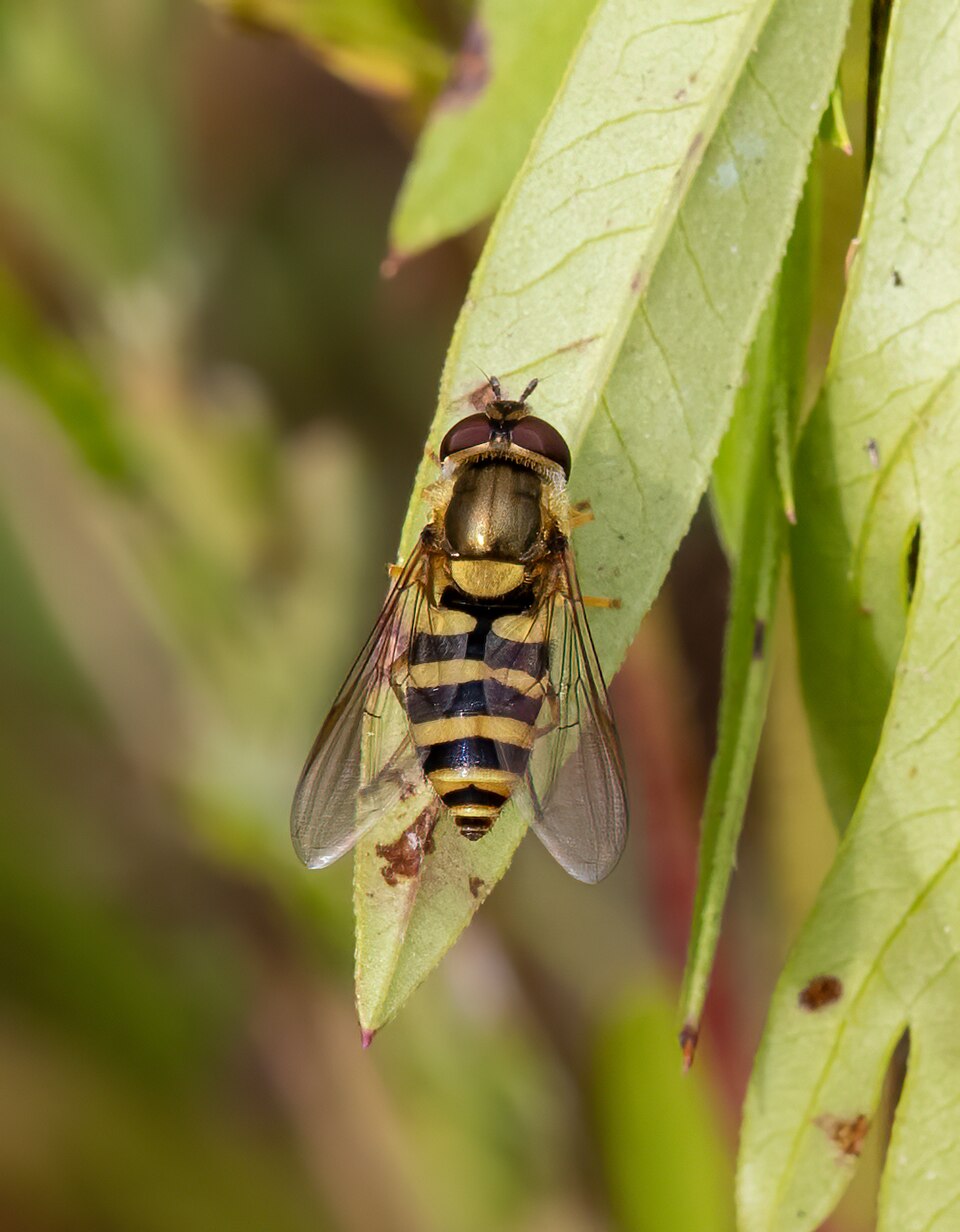
The yellow-legged flower fly is a hoverfly with bold black and yellow bands on its body. It is common in the eastern United States and Canada. It loves to visit flowers like daisies and sunflowers.
Lives in
Eastern United States and southeastern Canada, sometimes seen in Europe
Can it hurt you?
Harmless
Harmless. Its stripes make it look like a wasp, but it has no sting.
What does it eat?
The grown-up fly visits flowers of the sunflower family. Its larva hunts aphids.
How fast is it?
A person walking about 5 km/h (3.1 mph)
A kid running fast about 13 km/h (8.1 mph)
Yellow-legged flower fly about 14 km/h (8.7 mph)
A grown-up on a bike about 25 km/h (16 mph)
cool stuff
Fun facts
1
Its larva eats aphids, so gardeners are happy to have it around.
2
It flies for a long part of the year, from April to November.
3
Every now and then it has been seen in Europe, far from its home.
you asked
Most asked questions about Yellow-legged flower fly
?Does the yellow-legged flower fly sting?
No. It only looks a bit like a wasp. Hoverflies have no sting.
?What does the yellow-legged flower fly eat?
The adult visits flowers of the sunflower family, and the larva eats aphids.
For bug experts
- Scientific name
- Syrphus rectus
- Group
- Flies and mosquitoes
- Family
- Syrphidae
- Classification
- Insecta > Diptera > Syrphidae
- Lives on
- North America, Europe
Where the facts come from
- Syrphus rectus (Wikipedia, CC BY-SA 4.0): what it looks like, where it lives, what it eats, sizes and fun facts, retold in simple words.
- Picture by Rhododendrites. CC BY-SA 4.0, Wikimedia Commons. The sticker of this bug is drawn from this picture.
If we got something wrong, sorry, we are bug fans, not a science journal. Tell us at [email protected] and we will fix it.
Bug Wiki honey jar For grown-ups: Bug Wiki is free, with no ads and no tracking. A small tip helps keep it online.Leave a tip Housefly
 New World screwworm fly
 Lovebug
 Tsetse fly
 Common fruit fly
 Asian tiger mosquito
 Australian paper wasp
 Variegated fritillary
 Black field cricket
 Mediterranean false black widow
 Locust borer
 Yellow-faced bumblebee
.jpg)