
Peacock fly
Callopistromyia annulipes
Name means: “it raises its wings like a peacock fans its tail”

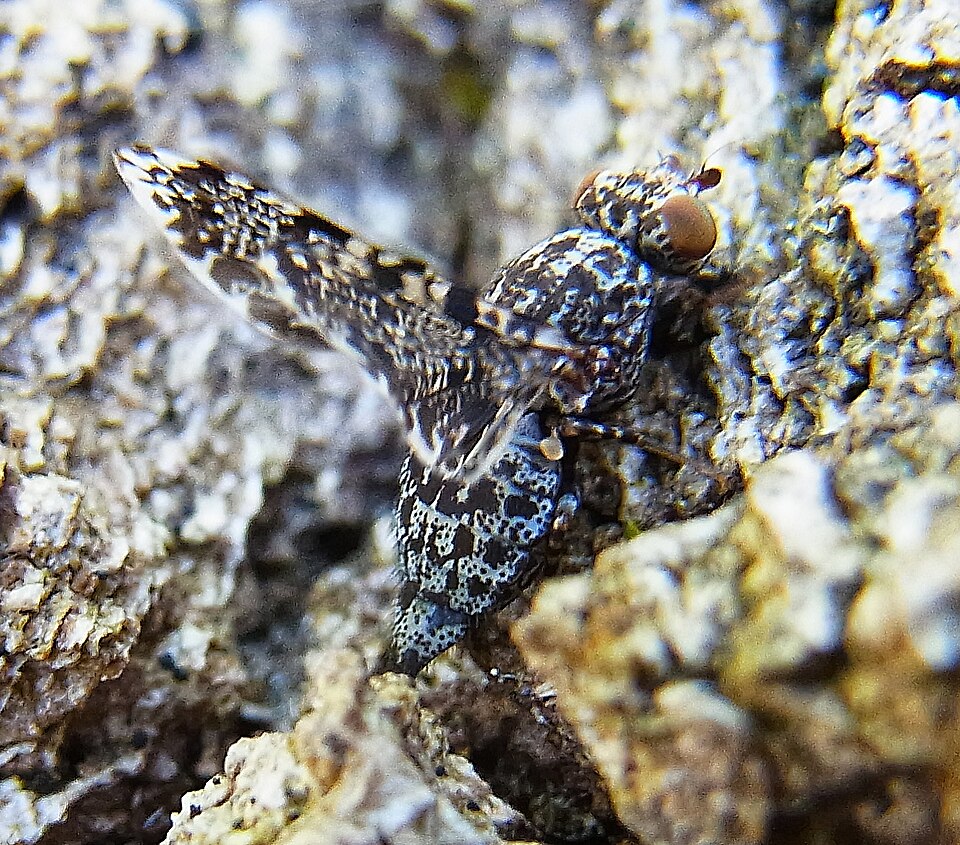
The peacock fly is a picture-winged fly with patterned wings. Males and females strut on rotting logs with their wings held straight up, like a peacock showing off its tail. Blue shimmers on the wings make the show even better.
Lives in
North America, and lately also many countries in Europe
Can it hurt you?
Harmless
Harmless. It cannot bite or sting.
What does it eat?
It lives on rotting trees and logs. Scientists still have a lot to learn about what it eats.
How fast is it?
A person walking about 5 km/h (3.1 mph)
Peacock fly about 8 km/h (5 mph)
A kid running fast about 13 km/h (8.1 mph)
A grown-up on a bike about 25 km/h (16 mph)
cool stuff
Fun facts
1
It comes from North America, but it travelled to Europe by accident.
2
In Europe it has now been found in more than 15 countries, from France to Ukraine.
3
Both males and females do the peacock dance on rotting wood.
you asked
Most asked questions about Peacock fly
?Why is it called the peacock fly?
Because it raises its patterned wings like a peacock fans its tail.
?Where does the peacock fly live?
In North America, and now also in many European countries.
For bug experts
- Scientific name
- Callopistromyia annulipes
- Group
- Flies and mosquitoes
- Family
- Ulidiidae
- Classification
- Insecta > Diptera > Ulidiidae
- Lives on
- North America, Europe
Where the facts come from
- Callopistromyia annulipes (Wikipedia, CC BY-SA 4.0): what it looks like, where it lives, what it eats, sizes and fun facts, retold in simple words.
- Picture by Siga. CC BY-SA 3.0, Wikimedia Commons. The sticker of this bug is drawn from this picture.
If we got something wrong, sorry, we are bug fans, not a science journal. Tell us at [email protected] and we will fix it.
Bug Wiki honey jar For grown-ups: Bug Wiki is free, with no ads and no tracking. A small tip helps keep it online.Leave a tip Housefly
 New World screwworm fly
 Lovebug
 Tsetse fly
 Common fruit fly
 Asian tiger mosquito
 Black-winged subterranean termite
 Blood-red longhorn beetle
 Diana treebrown
 Common jester
 Carpenter sawyer beetle
 The brick