
Wandering ringtail
Austrolestes leda
Name means: “the southern robber, named after Leda from old Greek stories”

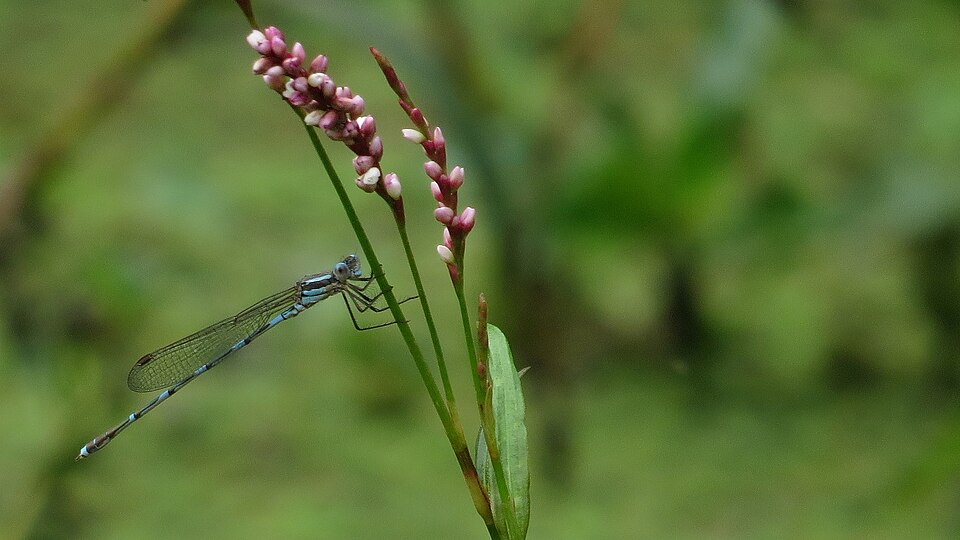
The wandering ringtail is a slim damselfly from eastern Australia. The male is light blue and black, like a little flying stick of blue and black beads. It is quite a big damselfly and likes calm water.
Lives in
Eastern Australia, at slow streams, ponds and still water
Can it hurt you?
Harmless
Harmless. Damselflies have no sting and do not bite people.
What does it eat?
It catches small flying insects. Its babies live in the water and hunt tiny water animals.
How fast is it?
A person walking about 5 km/h (3.1 mph)
Wandering ringtail about 10 km/h (6.2 mph)
A kid running fast about 13 km/h (8.1 mph)
A grown-up on a bike about 25 km/h (16 mph)
cool stuff
Fun facts
1
It likes water that moves slowly or stands still, like ponds and quiet creeks.
2
Its first name means southern robber, a good name for a little hunter from the south.
3
Its second name, leda, comes from Leda, a woman in old Greek stories.
you asked
Most asked questions about Wandering ringtail
?Is the wandering ringtail dangerous?
No. It has no sting and does not bite people, so you can watch it safely.
?Where does the wandering ringtail live?
In eastern Australia, near slow or still water.
For bug experts
- Scientific name
- Austrolestes leda
- Group
- Dragonflies and damselflies
- Family
- Lestidae
- Classification
- Insecta > Odonata > Lestidae
- Lives on
- Australia and Oceania
Where the facts come from
- Austrolestes leda (Wikipedia, CC BY-SA 4.0): what it looks like, where it lives, what it eats, sizes and fun facts, retold in simple words.
- Picture by John Tann from Sydney, Australia. CC BY 2.0, Wikimedia Commons. The sticker of this bug is drawn from this picture.
If we got something wrong, sorry, we are bug fans, not a science journal. Tell us at [email protected] and we will fix it.
Bug Wiki honey jar For grown-ups: Bug Wiki is free, with no ads and no tracking. A small tip helps keep it online.Leave a tip Emperor dragonfly
 Common whitetail
 Green darner
 Ebony jewelwing
 Globe skimmer
 Blue dasher
 Waterfall centipede
 Greenhead horse fly
 Banded mosquito
 Great diving beetle
 Water louse
 New Zealand mud snail
.jpg)