
Confused haploa moth
Haploa confusa

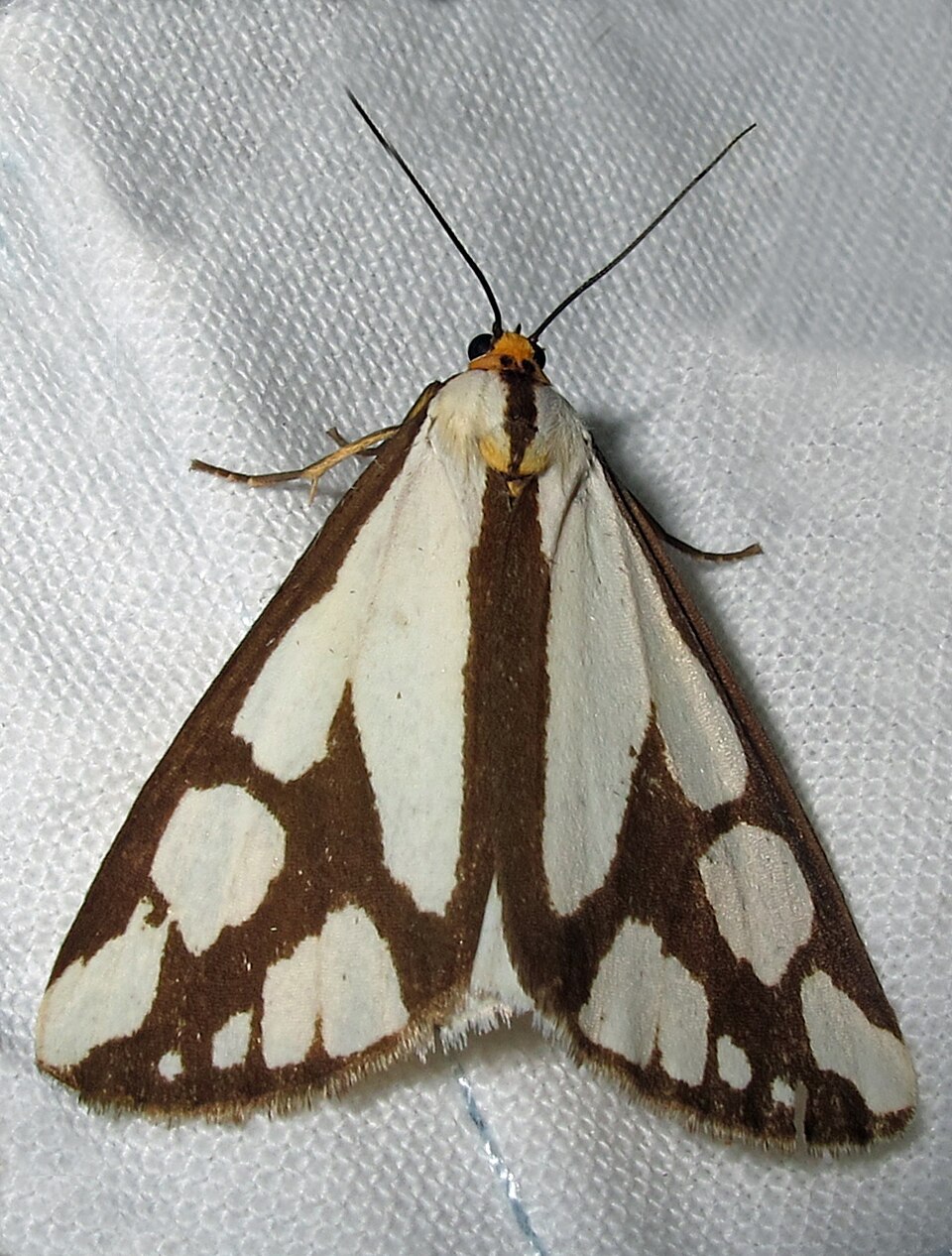
The confused haploa is a pretty moth from North America. Its front wings are cream coloured with brown patterns, and its back wings are almost pure white. Its caterpillar is black with bright yellow stripes.
Lives in
North America, in meadows and woodland edges
Can it hurt you?
Harmless
Harmless. It does not bite or sting.
What does it eat?
Its caterpillars eat many different plants, from dogwood and sugar maple to willow and honeysuckle.
How fast is it?
A person walking about 5 km/h (3.1 mph)
A kid running fast about 13 km/h (8.1 mph)
Confused haploa moth about 14 km/h (8.7 mph)
A grown-up on a bike about 25 km/h (16 mph)
cool stuff
Fun facts
1
Its caterpillar has a wide yellow stripe along each side and thinner ones on its back.
2
Its caterpillars have been seen eating at least seven different kinds of plants.
3
It was first described by a scientist named Lyman in 1887, which is why it is also called Lyman's haploa.
you asked
Most asked questions about Confused haploa moth
?What does the confused haploa caterpillar eat?
Many plants, such as dogwoods, sugar maple, willow, honeysuckle and purple loosestrife.
?Is the confused haploa moth harmful?
No. It is a harmless moth.
For bug experts
- Scientific name
- Haploa confusa
- Named by
- Lyman, 1887
- Group
- Moths
- Family
- Erebidae
- Classification
- Insecta > Lepidoptera > Erebidae
- Lives on
- North America
- Also known as
- Confused haploa, Lyman's haploa
Where the facts come from
- Haploa confusa (Wikipedia, CC BY-SA 4.0): what it looks like, where it lives, what it eats, sizes and fun facts, retold in simple words.
- Picture by Jacy Lucier. CC BY-SA 4.0, Wikimedia Commons. The sticker of this bug is drawn from this picture.
If we got something wrong, sorry, we are bug fans, not a science journal. Tell us at [email protected] and we will fix it.
Bug Wiki honey jar For grown-ups: Bug Wiki is free, with no ads and no tracking. A small tip helps keep it online.Leave a tip Atlas moth
 Luna moth
 Hummingbird hawk-moth
 Domestic silk moth
 Isabella tiger moth
 Polyphemus moth
 Red-thighed St Mark's fly
 Ant damselbug
 Cape Mountain cockroach
 Common garden orbweb spider
 Ghost bulimulus
 Two-lined stealthy ground spider