
Clapping cicada
Amphipsalta cingulata

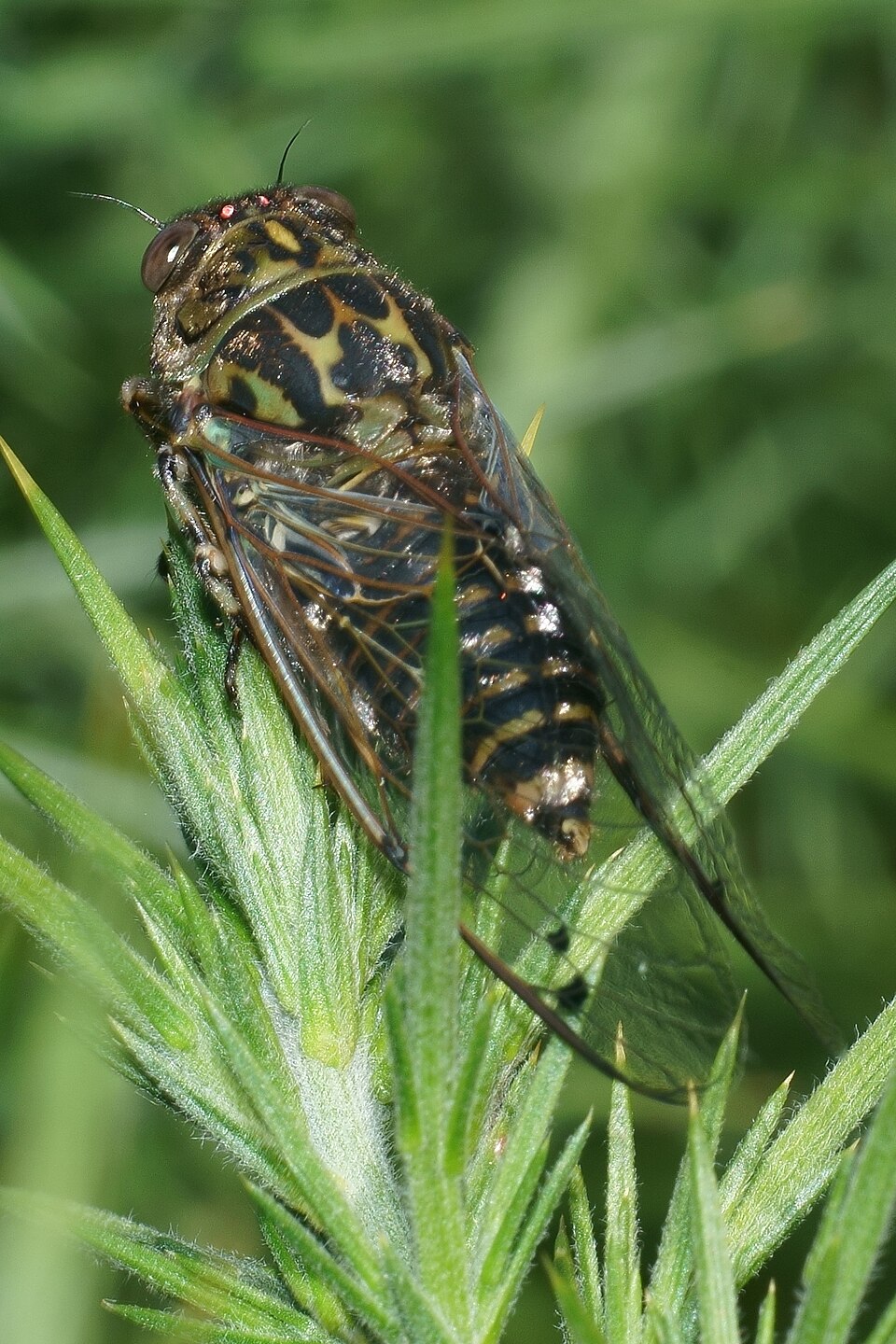
The clapping cicada is a cicada that lives only in New Zealand. It is found on the North Island and nowhere else in the world. It was one of the first New Zealand insects ever studied by European scientists.
Lives in
Only the North Island of New Zealand
Can it hurt you?
Harmless
Harmless. Cicadas do not sting and are safe to watch.
What does it eat?
Like other cicadas, it sucks sap from plants through its beak.
How fast is it?
A person walking about 5 km/h (3.1 mph)
Clapping cicada about 12 km/h (7.5 mph)
A kid running fast about 13 km/h (8.1 mph)
A grown-up on a bike about 25 km/h (16 mph)
cool stuff
Fun facts
1
The first ones were collected by the naturalist Joseph Banks on Captain Cook's ship Endeavour.
2
It was described in 1775 from just four specimens.
3
Scientists moved it to new genus groups several times before giving it its own genus in 1969.
you asked
Most asked questions about Clapping cicada
?Where does the clapping cicada live?
Only on the North Island of New Zealand.
?Is the clapping cicada dangerous?
No. Cicadas do not sting and are harmless.
For bug experts
- Scientific name
- Amphipsalta cingulata
- Named by
- Fabricius, 1775
- Group
- True bugs and cicadas
- Family
- Cicadidae
- Classification
- Insecta > Hemiptera > Cicadidae
- Lives on
- Australia and Oceania
Where the facts come from
- Amphipsalta cingulata (Wikipedia, CC BY-SA 4.0): what it looks like, where it lives, what it eats, sizes and fun facts, retold in simple words.
- Picture by Uwe Schneehagen Depicted place: Owhiro Bay, Wellington 6023, Neuseeland ( 41°19′51″S 174°45′52″E / 41.330898797°S 174.7645329664°E / -41.330898797; 174.76. CC BY-SA 4.0, Wikimedia Commons. The sticker of this bug is drawn from this picture.
If we got something wrong, sorry, we are bug fans, not a science journal. Tell us at [email protected] and we will fix it.
Bug Wiki honey jar For grown-ups: Bug Wiki is free, with no ads and no tracking. A small tip helps keep it online.Leave a tip Pharaoh cicada
 Spotted lanternfly
 Brown marmorated stink bug
 Cochineal
 Boxelder bug
 Western conifer seed bug
 Grain support beetle
 Laurel sphinx
 Banded hickory borer
 Brown elfin
 Titan stick insect
 Large emerald