
Stained-glass moth
Samea castellalis

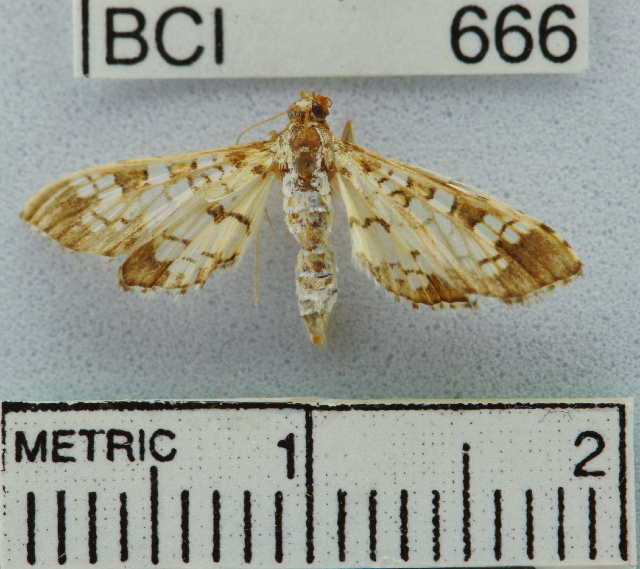
The stained-glass moth is a small moth from the Americas. It belongs to the grass moth family. In warm places it can be seen flying almost all year round.
Lives in
From Argentina and Brazil up through Central America and Mexico to the southern United States
Can it hurt you?
Harmless
Harmless. It cannot bite or sting.
What does it eat?
Not much is written about what it eats. Like most moths, the grown-ups sip sweet juice from flowers.
How fast is it?
A person walking about 5 km/h (3.1 mph)
A kid running fast about 13 km/h (8.1 mph)
Stained-glass moth about 14 km/h (8.7 mph)
A grown-up on a bike about 25 km/h (16 mph)
cool stuff
Fun facts
1
In the southern part of where it lives, grown-ups fly nearly the whole year.
2
It lives in many countries, from Argentina in the south to North Carolina in the north.
3
In the United States it is found from North Carolina down to Florida and west to Texas.
you asked
Most asked questions about Stained-glass moth
?Is the stained-glass moth dangerous?
No. It is a small moth and cannot bite or sting.
?Where does the stained-glass moth live?
In South America, Central America, Mexico and the southern United States.
For bug experts
- Scientific name
- Samea castellalis
- Group
- Moths
- Family
- Crambidae
- Classification
- Insecta > Lepidoptera > Crambidae
- Lives on
- South America, North America
Where the facts come from
- Samea ecclesialis (Wikipedia, CC BY-SA 4.0): what it looks like, where it lives, what it eats, sizes and fun facts, retold in simple words.
- Picture by Unspecified. Public domain, Wikimedia Commons. The sticker of this bug is drawn from this picture.
If we got something wrong, sorry, we are bug fans, not a science journal. Tell us at [email protected] and we will fix it.
Bug Wiki honey jar For grown-ups: Bug Wiki is free, with no ads and no tracking. A small tip helps keep it online.Leave a tip Atlas moth
 Luna moth
 Hummingbird hawk-moth
 Domestic silk moth
 Isabella tiger moth
 Polyphemus moth
 Plain orange-tip
 Common straight swift
 Small black sugar ant
 Eastern baton blue
 Oleander seedbug
 Dark-veined white