
Orange-tailed marsh dart
Ceriagrion cerinorubellum

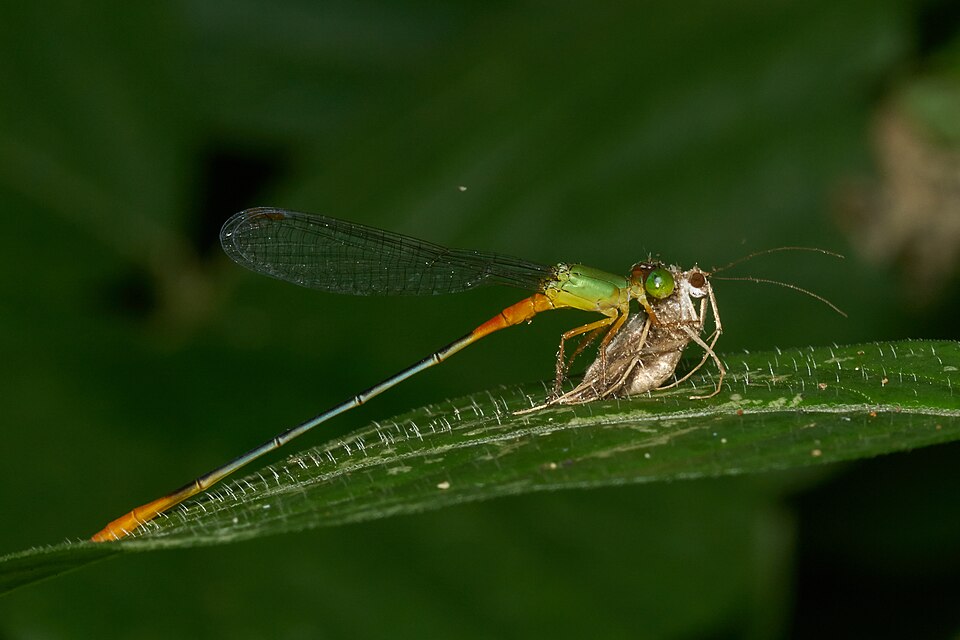
The orange-tailed marsh dart is a damselfly with a yellow-green chest and a tail that is brick red at both ends. Its greenish eyes are blue on top. It is one of the most common damselflies in Asia.
Lives in
South and Southeast Asia and China, at weedy ponds and marshes
Can it hurt you?
Harmless
Harmless. Damselflies do not sting.
What does it eat?
Like all damselflies, it catches small flying insects.
How fast is it?
A person walking about 5 km/h (3.1 mph)
Orange-tailed marsh dart about 10 km/h (6.2 mph)
A kid running fast about 13 km/h (8.1 mph)
A grown-up on a bike about 25 km/h (16 mph)
cool stuff
Fun facts
1
The middle part of its tail is black on top and pale blue underneath.
2
The female looks like the male, but sturdier and with duller colours.
3
It lays its eggs in weedy ponds, marshes and other still water.
you asked
Most asked questions about Orange-tailed marsh dart
?Is the orange-tailed marsh dart dangerous?
No. Damselflies cannot sting and are harmless.
?Where does the orange-tailed marsh dart live?
In much of Asia, from India and Sri Lanka to China, the Philippines and Indonesia.
For bug experts
- Scientific name
- Ceriagrion cerinorubellum
- Group
- Dragonflies and damselflies
- Family
- Coenagrionidae
- Classification
- Insecta > Odonata > Coenagrionidae
- Lives on
- Asia
- Also known as
- Bi-coloured damsel
Where the facts come from
- Ceriagrion cerinorubellum (Wikipedia, CC BY-SA 4.0): what it looks like, where it lives, what it eats, sizes and fun facts, retold in simple words.
- Picture by Jeevan Jose, Kerala, India. CC BY-SA 4.0, Wikimedia Commons. The sticker of this bug is drawn from this picture.
If we got something wrong, sorry, we are bug fans, not a science journal. Tell us at [email protected] and we will fix it.
Bug Wiki honey jar For grown-ups: Bug Wiki is free, with no ads and no tracking. A small tip helps keep it online.Leave a tip Emperor dragonfly
 Common whitetail
 Green darner
 Ebony jewelwing
 Globe skimmer
 Blue dasher
 Halcyon giant centipede
 Petroleum fly
 Buzzer midge
 Summer fishfly
 Pennsylvania firefly
 Giant salmonfly