
Viereck's sweat bee
Lasioglossum vierecki

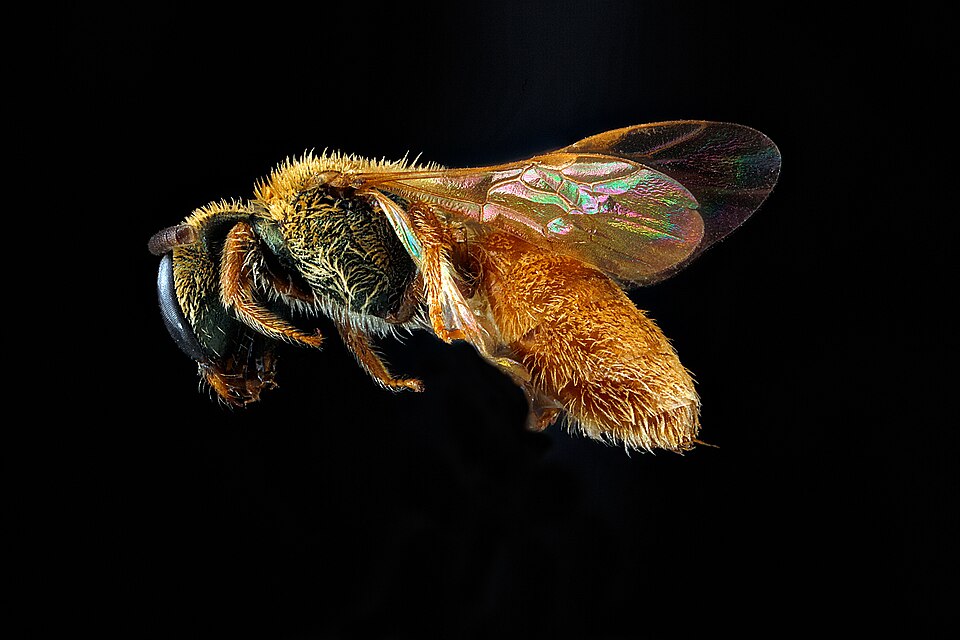
Viereck's sweat bee is a small, very hairy bee with an orange-yellow back end. It loves sandy places and makes its nest in the sand. It visits lots of wild flowers in eastern North America.
Lives in
Eastern North America, from Minnesota and Ontario down to Georgia and Louisiana, in sandy places
What does it eat?
It drinks nectar and collects pollen from flowers such as goldenrod, sunflowers and bee balm.
How fast is it?
A kid running fast about 13 km/h (8.1 mph)
Viereck's sweat bee about 22 km/h (14 mph)
A grown-up on a bike about 25 km/h (16 mph)
A car driving in town about 50 km/h (31 mph)
cool stuff
Fun facts
1
It is a sand specialist, which means it nests only in sandy ground.
2
It lives alone. Each mother bee builds her own nest and raises all her young by herself.
3
You can see it flying from April to September.
4
Males are smaller than females.
5
Some farmers grow native wild flowers to help bees like this one, because they pollinate crops.
you asked
Most asked questions about Viereck's sweat bee
?Where does Viereck's sweat bee live?
In eastern North America, in sandy places from Minnesota and Ontario down to Georgia and Louisiana.
For bug experts
- Scientific name
- Lasioglossum vierecki
- Group
- Bees and bumblebees
- Family
- Halictidae
- Classification
- Insecta > Hymenoptera > Halictidae
- Lives on
- North America
Where the facts come from
- Lasioglossum vierecki (Wikipedia, CC BY-SA 4.0): what it looks like, where it lives, what it eats, sizes and fun facts, retold in simple words.
- Picture by USGS Native Bee Inventory and Monitoring Laboratory. Public domain, Wikimedia Commons. The sticker of this bug is drawn from this picture.
If we got something wrong, sorry, we are bug fans, not a science journal. Tell us at [email protected] and we will fix it.
Bug Wiki honey jar For grown-ups: Bug Wiki is free, with no ads and no tracking. A small tip helps keep it online.Leave a tip Western honey bee
 Buff-tailed bumblebee
 Violet carpenter bee
 Giant honey bee
 Wallace's giant bee
 Himalayan giant honey bee
 Southern yellowwinged grasshopper
 Purple meadow bush-cricket
 Hyatt's big-headed ant
 Ponderous spur-throat grasshopper
 Nepalese turtle beetle
 White-winged orbweaver spider