
African mole cricket
Gryllotalpa africana

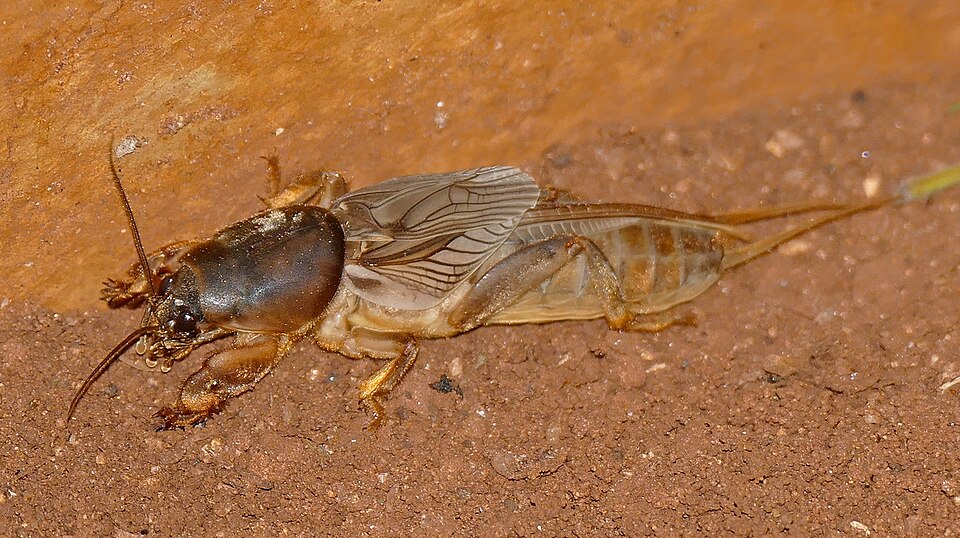
The African mole cricket lives underground like a little mole. It digs tunnels with its strong front legs. It only comes up at night, and it can even fly.
Lives in
Africa, with some living in Asia and southern Europe
Can it hurt you?
Harmless
Harmless. It does not sting. If you find one, put it gently back on the soil.
What does it eat?
It eats plant roots, and also grubs and other insects it finds underground.
How fast is it?
African mole cricket about 3 km/h (1.9 mph)
A person walking about 5 km/h (3.1 mph)
A kid running fast about 13 km/h (8.1 mph)
A grown-up on a bike about 25 km/h (16 mph)
cool stuff
Fun facts
1
Males sing to call females with a chirping song.
2
It flies when it moves to a new place or when a female goes looking for a male.
3
Some kinds of it look exactly alike and can only be told apart by their songs.
4
It is small for a mole cricket.
you asked
Most asked questions about African mole cricket
?What does the African mole cricket eat?
Plant roots, grubs and other small insects under the ground.
?Can mole crickets fly?
Yes. It flies at night when it moves to a new home or looks for a mate.
For bug experts
- Scientific name
- Gryllotalpa africana
- Named by
- Palisot de Beauvois, 1805
- Group
- Grasshoppers and crickets
- Family
- Gryllotalpidae
- Classification
- Insecta > Orthoptera > Gryllotalpidae
- Lives on
- Africa, Asia, Europe
Where the facts come from
- Gryllotalpa africana (Wikipedia, CC BY-SA 4.0): what it looks like, where it lives, what it eats, sizes and fun facts, retold in simple words.
- Picture by Bernard DUPONT from FRANCE. CC BY-SA 2.0, Wikimedia Commons. The sticker of this bug is drawn from this picture.
If we got something wrong, sorry, we are bug fans, not a science journal. Tell us at [email protected] and we will fix it.
Bug Wiki honey jar For grown-ups: Bug Wiki is free, with no ads and no tracking. A small tip helps keep it online.Leave a tip Desert locust
 House cricket
 Parktown prawn
 Eastern lubber grasshopper
 Australian plague locust
 Mormon cricket
 Giant peacock moth
 Texas brown tarantula
 Green huntsman spider
 Emperor moth
 Orange-tip
 Notch-horned cleg
_(16643378886).jpg)