
Common loopwing aphideater
Lapposyrphus lapponicus

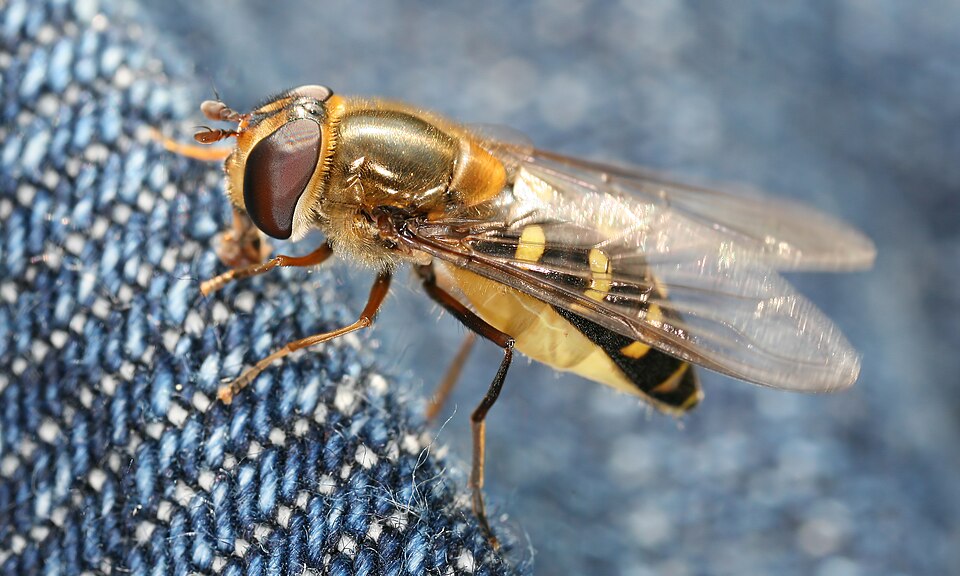
The common loopwing aphideater is a hoverfly, a fly that hovers in the air like a tiny helicopter. You often see it resting on flowers. Its young are hungry little helpers that eat aphids.
Lives in
Across the northern half of the world, on flowers
Can it hurt you?
Harmless
Harmless. It does not bite or sting people.
What does it eat?
The grown-ups drink nectar for energy and eat pollen for protein. The larvae eat aphids.
How fast is it?
A person walking about 5 km/h (3.1 mph)
A kid running fast about 13 km/h (8.1 mph)
Common loopwing aphideater about 14 km/h (8.7 mph)
A grown-up on a bike about 25 km/h (16 mph)
cool stuff
Fun facts
1
It is common all across the Northern Hemisphere.
2
In Europe it is called the Lapland syrphid fly.
3
Its larvae help gardeners, because they eat aphids that suck plant juice.
you asked
Most asked questions about Common loopwing aphideater
?Is the loopwing aphideater a bee?
No. It is a fly. It cannot sting.
?What does the loopwing aphideater eat?
The grown-ups eat nectar and pollen. The larvae eat aphids.
For bug experts
- Scientific name
- Lapposyrphus lapponicus
- Named by
- Zetterstedt, 1838
- Group
- Flies and mosquitoes
- Family
- Syrphidae
- Classification
- Insecta > Diptera > Syrphidae
- Lives on
- Europe, Asia, North America
- Also known as
- Lapland syrphid fly
Where the facts come from
- Lapposyrphus lapponicus (Wikipedia, CC BY-SA 4.0): what it looks like, where it lives, what it eats, sizes and fun facts, retold in simple words.
- Picture by Richard Bartz, Munich, Germany aka Makro Freak. CC BY-SA 2.5, Wikimedia Commons. The sticker of this bug is drawn from this picture.
If we got something wrong, sorry, we are bug fans, not a science journal. Tell us at [email protected] and we will fix it.
Bug Wiki honey jar For grown-ups: Bug Wiki is free, with no ads and no tracking. A small tip helps keep it online.Leave a tip Housefly
 New World screwworm fly
 Lovebug
 Tsetse fly
 Common fruit fly
 Asian tiger mosquito
 Pied shield bug
 Oriental spiny orb-weaver
 Hairless rover ant
 Green mountain grasshopper
 Hairy rose beetle
 Blackberry looper moth