
Orange-belted plumehorn
Volucella inflata

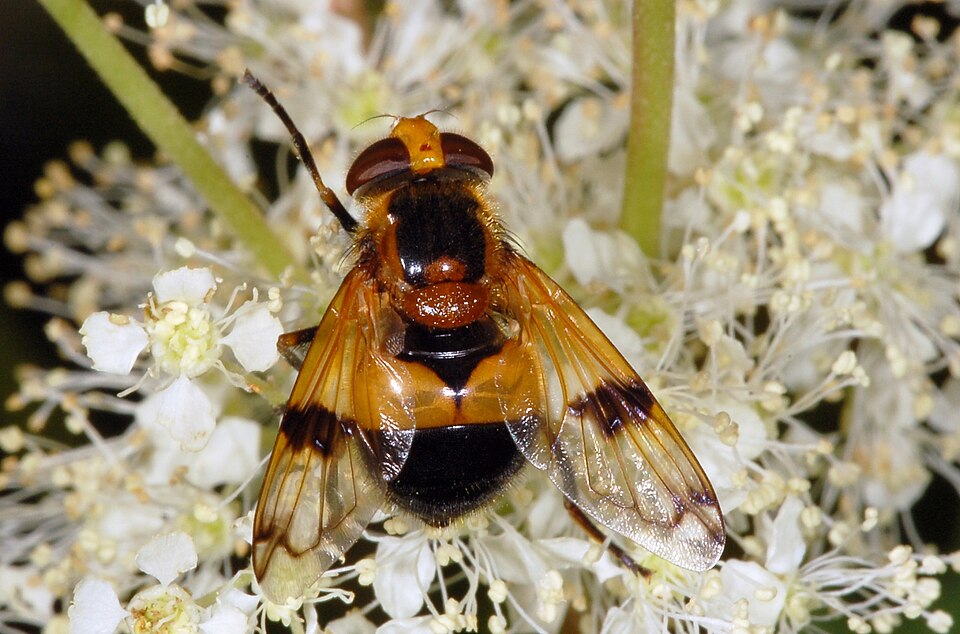
The orange-belted plumehorn is a big hoverfly from Europe. Its middle is black with orange edges, and its tummy is black with orange-brown patches. It loves visiting flowers in old forests.
Lives in
Patchy across Europe, from Sweden and Britain to Spain, Russia and the Caucasus, in old leafy forests
Length
1.2 to 1.5 cm (0.47 to 0.59 in)
Can it hurt you?
Harmless
Harmless. Hoverflies cannot sting, even though some look a bit like wasps or bees.
What does it eat?
The grown-ups drink nectar, mostly from flat flower clusters like cow parsley. The babies grow up inside the nests of insects that live together in big groups.
How big is it?
How long is it?
🍚as long as 2.5 grains of rice in a row⚽could fly across a whole football pitch in 24 seconds⚡moves 300 times its own body length every second
How big is Orange-belted plumehorn compared to YOU?
Just maths in your browser. Nothing is saved or sent anywhere.
How fast is it?
A kid running fast about 13 km/h (8.1 mph)
Orange-belted plumehorn about 16 km/h (9.9 mph)
A grown-up on a bike about 25 km/h (16 mph)
A car driving in town about 50 km/h (31 mph)
cool stuff
Fun facts
1
Each of its wings is about 11 to 13 millimetres long.
2
You can see the grown-ups flying from May to July.
3
Its babies live inside the nests of social insects, which share one big home.
4
It mostly stays in forests with big old trees, but now and then it visits gardens.
you asked
Most asked questions about Orange-belted plumehorn
?Can the orange-belted plumehorn sting?
No. It is a hoverfly, and hoverflies have no sting.
?How big is the orange-belted plumehorn?
Its body is about 12 to 15 millimetres long.
For bug experts
- Scientific name
- Volucella inflata
- Group
- Flies and mosquitoes
- Family
- Syrphidae
- Classification
- Insecta > Diptera > Syrphidae
- Lives on
- Europe
Where the facts come from
- Volucella inflata (Wikipedia, CC BY-SA 4.0): what it looks like, where it lives, what it eats, sizes and fun facts, retold in simple words.
- Picture by Fritz Geller-Grimm. CC BY-SA 3.0, Wikimedia Commons. The sticker of this bug is drawn from this picture.
If we got something wrong, sorry, we are bug fans, not a science journal. Tell us at [email protected] and we will fix it.
Bug Wiki honey jar For grown-ups: Bug Wiki is free, with no ads and no tracking. A small tip helps keep it online.Leave a tip Housefly
 New World screwworm fly
 Lovebug
 Tsetse fly
 Common fruit fly
 Asian tiger mosquito
 Pine white
 Elm spanworm moth
 Once-married underwing
 Arched hooktip moth
 Pale awlet
 Cassin's 13-year cicada