

Black-veined white
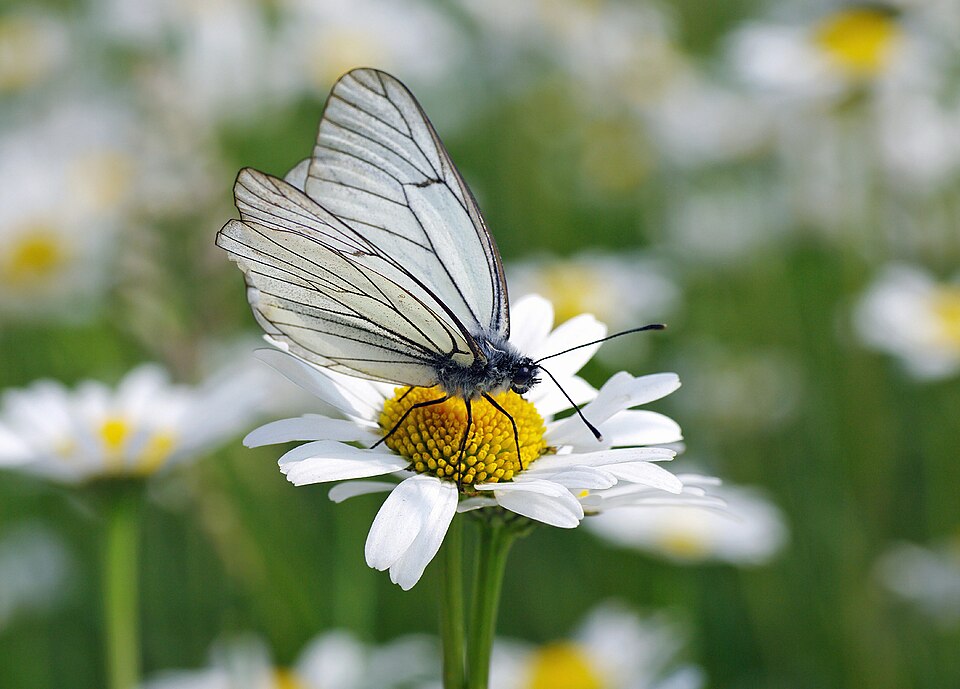
The black-veined white is a big white butterfly with bold black lines on its wings, like a drawing done with a black pen. The lines are the veins of its wings. It flutters over meadows, orchards and gardens in late spring and early summer.
How big is it?
How wide are its wings?
How big is Black-veined white compared to YOU?
Just maths in your browser. Nothing is saved or sent anywhere.
How fast is it?
Fun facts
A female rubs her wings together so much that she loses most of their scales. Her wings can become almost see-through.
Long ago, people saw red drops on the ground and thought it had rained blood. The drops really came from lots of these butterflies leaving their pupae at the same time.
The caterpillars spend the winter together in little silk nests on the trees.
Its pupa is creamy white with black marks and is tied to a twig with a belt of silk.
It has disappeared from Britain, but people have tried to bring it back to southern England.
Most asked questions about Black-veined white
?What does the black-veined white eat?
The butterflies drink flower nectar. The caterpillars eat leaves of hawthorn, blackthorn, plum and pear trees.
?How big is the black-veined white?
Its wings measure about 5 to 7 centimetres from tip to tip. Females are usually a bit bigger than males.
?When can you see a black-veined white?
It flies from April to July, in meadows, orchards, gardens and the edges of woods.
Myth buster
Myth: Red drops on the ground long ago meant that it had rained blood.
Truth: It never rained blood. The red drops came from black-veined whites when lots of them came out of their pupae at the same time.
For bug experts
- Scientific name
- Aporia crataegi
- Named by
- Linnaeus, 1758
- Group
- Butterflies
- Family
- Pieridae
- Classification
- Insecta > Lepidoptera > Pieridae
- Lives on
- Europe, Asia, Africa
Where the facts come from
- Aporia crataegi (Wikipedia, CC BY-SA 4.0): what it looks like, where it lives, what it eats, sizes and fun facts, retold in simple words.
- Picture by Christian Fischer. CC BY-SA 3.0, Wikimedia Commons. The round sticker of this bug is cut from the same picture.
If we got something wrong, sorry, we are bug fans, not a science journal. Tell us at [email protected] and we will fix it.
 Monarch butterfly
 Peacock butterfly
 Blue morpho
 Old World swallowtail
 Small white
 Eastern tiger swallowtail
 Horse-chestnut leaf miner
 Pill millipede
 Beet armyworm
 Transverse ladybird
 European orchard bee
 Cream-spot ladybird