

Buck moth
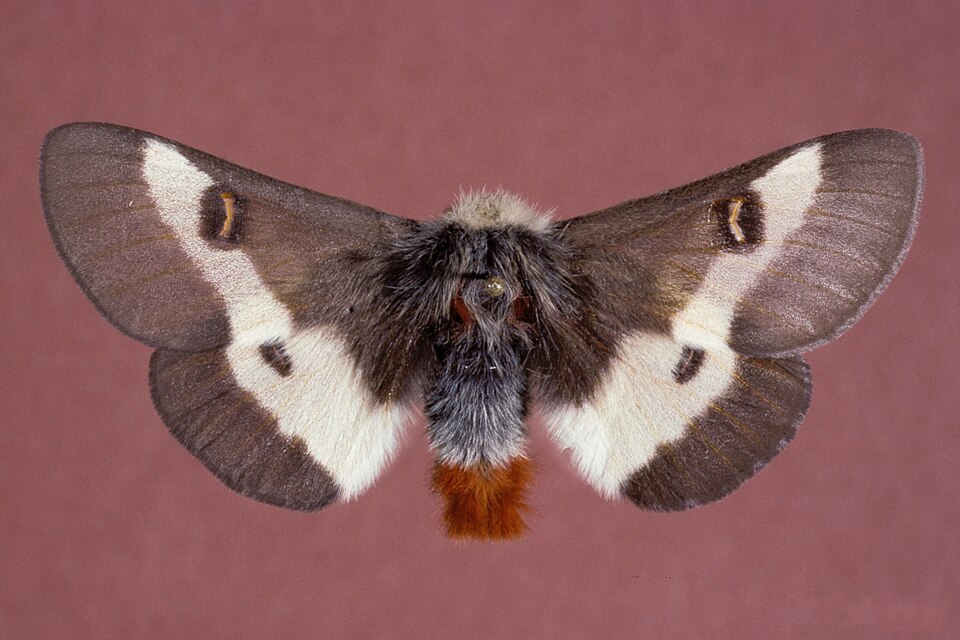
The buck moth is a dark grey, almost black moth with a white stripe across each wing. On every stripe there is a little eye spot. It flies in autumn, when most other moths have already gone.
How big is it?
How wide are its wings?
How big is Buck moth compared to YOU?
Just maths in your browser. Nothing is saved or sent anywhere.
How fast is it?
Fun facts
The mother lays about 150 eggs in a tight ring around an oak twig. The eggs wait there all winter.
You can tell boys from girls: the male has a rusty red tail end, while the female is black all over.
A fully grown caterpillar can be about 6 centimetres long.
Most asked questions about Buck moth
?What does a buck moth caterpillar eat?
It eats the leaves of oak trees, like live oak and white oak.
?When do buck moths fly?
The grown-up moths fly in autumn, mostly in October and November.
For bug experts
- Scientific name
- Hemileuca maia
- Named by
- Drury, 1773
- Group
- Moths
- Family
- Saturniidae
- Classification
- Insecta > Lepidoptera > Saturniidae
- Lives on
- North America
- Also known as
- Buckmoth
Where the facts come from
- Buck moth (Wikipedia, CC BY-SA 4.0): what it looks like, where it lives, what it eats, sizes and fun facts, retold in simple words.
- Picture by Gerald J. Lenhard, Lousiana State Univ, Bugwood.org. CC BY 3.0 us, Wikimedia Commons. The round sticker of this bug is cut from the same picture.
If we got something wrong, sorry, we are bug fans, not a science journal. Tell us at [email protected] and we will fix it.
 Atlas moth
 Luna moth
 Hummingbird hawk-moth
 Domestic silk moth
 Isabella tiger moth
 Polyphemus moth
 Spined micrathena
 Goliath stick insect
 Black and gold flat millipede
 Golden stag beetle
 Knopper gall wasp
 Cottonwood borer