

Chinese tussar moth
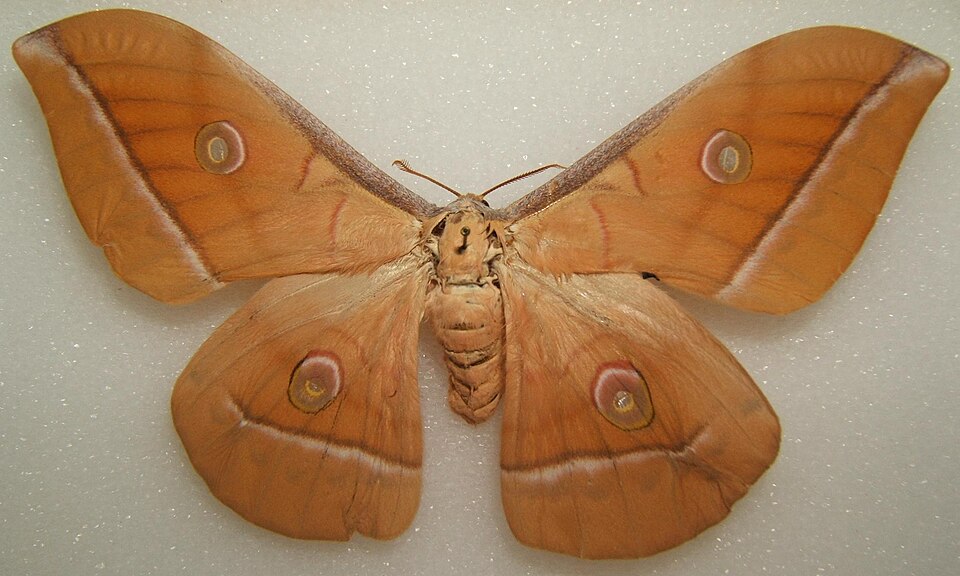
The Chinese tussar moth is a big silk moth from southern China. Its caterpillar spins a cocoon of silk, and people have used that silk to make cloth for more than 2000 years. Unlike the farm silkworm, it can also live in the wild on its own.
How fast is it?
Fun facts
Its silk is called tussah silk, and it was already important in China about 2200 years ago.
The colour and quality of its silk change with the weather and the soil where it grows.
If it escapes from a silk farm, it can survive in the wild, which the farm silkworm cannot do.
It is a cousin of the big American polyphemus moth.
Most asked questions about Chinese tussar moth
?What is tussah silk?
It is silk made from the cocoons of the Chinese tussar moth and its relatives.
?What does the Chinese tussar moth eat?
Its caterpillars eat oak leaves. The grown-up moths do not eat.
?Where does the Chinese tussar moth come from?
From southern China. People have spread it to other parts of Asia for silk.
For bug experts
- Scientific name
- Antheraea pernyi
- Named by
- Guérin-Méneville, 1855
- Group
- Moths
- Family
- Saturniidae
- Classification
- Insecta > Lepidoptera > Saturniidae
- Lives on
- Asia
- Also known as
- Chinese oak tussar moth, Chinese tasar moth, Temperate tussar moth
Where the facts come from
- Antheraea pernyi (Wikipedia, CC BY-SA 4.0): what it looks like, where it lives, what it eats, sizes and fun facts, retold in simple words.
- Picture by No machine-readable author provided. Kugamazog~commonswiki assumed (based on copyright claims).. CC BY-SA 2.5, Wikimedia Commons. The round sticker of this bug is cut from the same picture.
If we got something wrong, sorry, we are bug fans, not a science journal. Tell us at [email protected] and we will fix it.
 Atlas moth
 Luna moth
 Hummingbird hawk-moth
 Domestic silk moth
 Isabella tiger moth
 Polyphemus moth
 Giant burrowing cockroach
 Mountain pine beetle
 Magnolia green jumper
 Social huntsman spider
 Reddish-brown stag beetle
 Wasp mantidfly