

Common spangle gall wasp
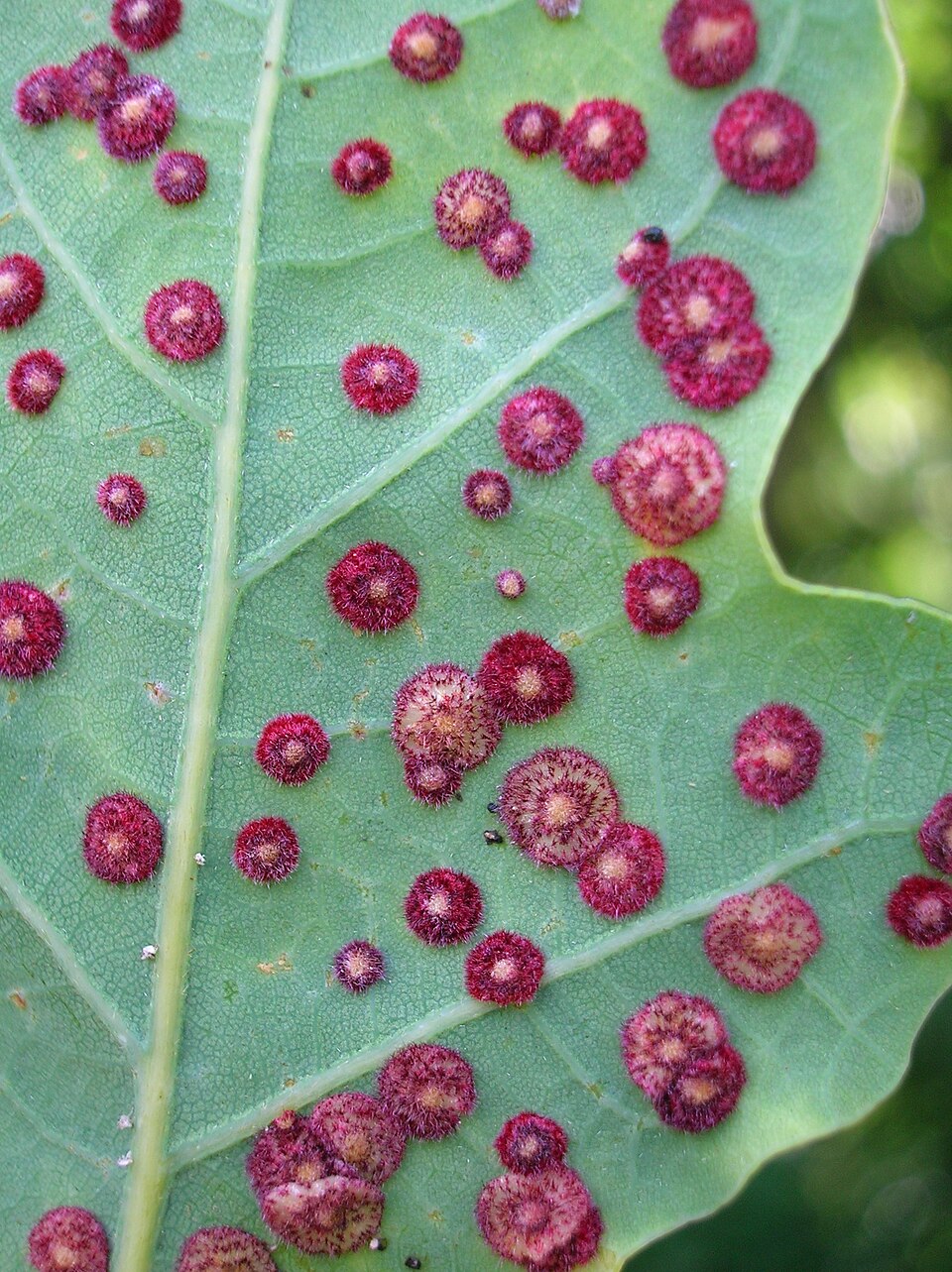
The common spangle gall wasp is a tiny wasp that turns oak leaves into little nurseries. Where it lays an egg, the leaf grows a round bump called a gall, and the baby wasp lives safely inside. On the underside of oak leaves these galls look like small flat buttons, called spangles.
How fast is it?
Fun facts
It has two kinds of families that take turns each year. One makes flat spangle galls on leaves, the next makes round galls on oak catkins.
The round galls turn from green to pink to red and look just like redcurrant berries.
In September the spangles drop off the leaves, and the larva spends the winter inside its spangle on the ground, under a blanket of fallen leaves.
One oak leaf can have 80 to 100 spangle galls on its underside.
So many spangles fall in autumn that they can cover the ground, and game birds like to eat them.
Most asked questions about Common spangle gall wasp
?What are the little discs under oak leaves?
They are often spangle galls. Each one is a tiny home for a gall wasp larva.
?Do spangle galls harm oak trees?
No. Even lots of galls do not seriously harm the tree.
For bug experts
- Scientific name
- Neuroterus quercusbaccarum
- Group
- Wasps and hornets
- Family
- Cynipidae
- Classification
- Insecta > Hymenoptera > Cynipidae
- Lives on
- Europe, Asia, Africa
Where the facts come from
- Neuroterus quercusbaccarum (Wikipedia, CC BY-SA 4.0): what it looks like, where it lives, what it eats, sizes and fun facts, retold in simple words.
- Picture by Rosser1954 Roger Griffith. Public domain, Wikimedia Commons. The round sticker of this bug is cut from the same picture.
If we got something wrong, sorry, we are bug fans, not a science journal. Tell us at [email protected] and we will fix it.
 European hornet
 Northern giant hornet
 Bald-faced hornet
 Red velvet ant
 Eastern cicada killer
 Asian hornet
 Puriri moth
 Red triangle slug
 Canadian tiger swallowtail
 California dogface
 Great capricorn beetle
 Fringed jumping spider