

Cook Strait giant wētā
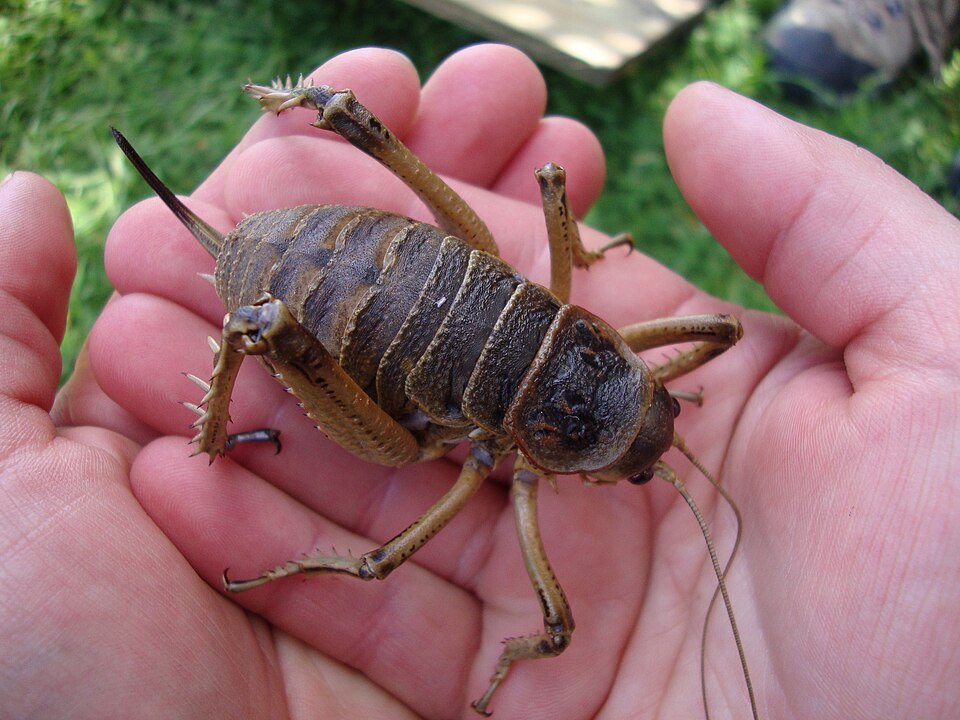
The Cook Strait giant wētā is one of the biggest insects in the world. It is a huge, wingless cricket cousin with a bulky brown and yellow body covered in armour plates. It lives only in New Zealand and comes out at night to munch on plants.
How big is it?
How long is it?
How big is Cook Strait giant wētā compared to YOU?
Just maths in your browser. Nothing is saved or sent anywhere.
How fast is it?
Fun facts
When it is scared, it lifts its spiky back legs over its head, waves them and hisses by rubbing its back plates together.
Neither the males nor the females have wings.
A male may walk more than 250 metres in one night to find a female, following her smell.
Rats and loss of its home made it vanish from the New Zealand mainland. In 2007 people brought it back after more than 100 years.
During the day it hides under dead leaves, bark or stones, or in a little hollow in the soil.
Most asked questions about Cook Strait giant wētā
?How big is the Cook Strait giant wētā?
It can grow up to 7 centimetres long, which makes it one of the biggest insects in the world.
?Is a giant wētā dangerous?
No. It may kick its spiky legs and hiss when scared, but it is not dangerous.
?Where does the Cook Strait giant wētā live?
Only in New Zealand, mostly on small islands without rats.
For bug experts
- Scientific name
- Deinacrida rugosa
- Group
- Grasshoppers and crickets
- Family
- Anostostomatidae
- Classification
- Insecta > Orthoptera > Anostostomatidae
- Lives on
- Australia and Oceania
- Also known as
- Stephens Island wētā
Where the facts come from
- Deinacrida rugosa (Wikipedia, CC BY-SA 4.0): what it looks like, where it lives, what it eats, sizes and fun facts, retold in simple words.
- Picture by Wvermaat. Public domain, Wikimedia Commons. The round sticker of this bug is cut from the same picture.
If we got something wrong, sorry, we are bug fans, not a science journal. Tell us at [email protected] and we will fix it.
 Desert locust
 House cricket
 Parktown prawn
 Eastern lubber grasshopper
 Australian plague locust
 Mormon cricket
 Brown marmorated stink bug
 Harlequin ladybird
 Spotted orb-weaver
 Cockchafer
 Red velvet ant
 Giant African land snail