

Death's head cockroach
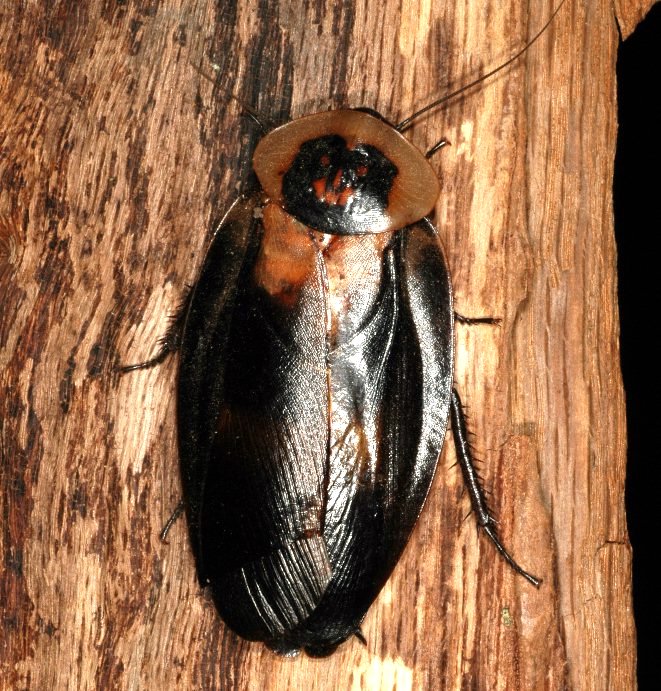
The death's head cockroach is a big cockroach with a funny pattern behind its head that looks like a little skull. Its wings have a black mark like a cloak. It lives on the forest floor and many people keep it as a pet.
How fast is it?
Fun facts
Cockroaches like this one have a tiny extra heart in each feeler to pump blood through them.
When an enemy comes near, it digs itself into soft ground with its head to hide.
The grown-ups have wings with pink flying muscles, but they usually only glide a short way.
The mother keeps her eggs in a pouch inside her body for about two months, until the babies are ready.
It can grow back some parts of a hurt leg.
Most asked questions about Death's head cockroach
?Is the death's head cockroach dangerous?
No. It is a calm insect that people often keep as a pet.
?Why is it called death's head?
Because the pattern behind its head looks like a skull.
?What does a death's head cockroach eat?
In the wild it eats leaves and other bits of food it finds. Pets eat fruit and vegetables.
For bug experts
- Scientific name
- Blaberus craniifer
- Group
- Cockroaches and termites
- Family
- Blaberidae
- Classification
- Insecta > Blattodea > Blaberidae
- Lives on
- North America
Where the facts come from
- Death's head cockroach (Wikipedia, CC BY-SA 4.0): what it looks like, where it lives, what it eats, sizes and fun facts, retold in simple words.
- Picture by Acrocynus. CC BY-SA 3.0, Wikimedia Commons. The round sticker of this bug is cut from the same picture.
If we got something wrong, sorry, we are bug fans, not a science journal. Tell us at [email protected] and we will fix it.
 Madagascar hissing cockroach
 German cockroach
 American cockroach
 Oriental cockroach
 Florida woods cockroach
 Asian cockroach
 Cobalt blue tarantula
 Giraffe weevil
 Giant tiger land snail
 Madagascan sunset moth
 Greater banded hornet
 Ulysses butterfly