
Goblet-marked damselfly

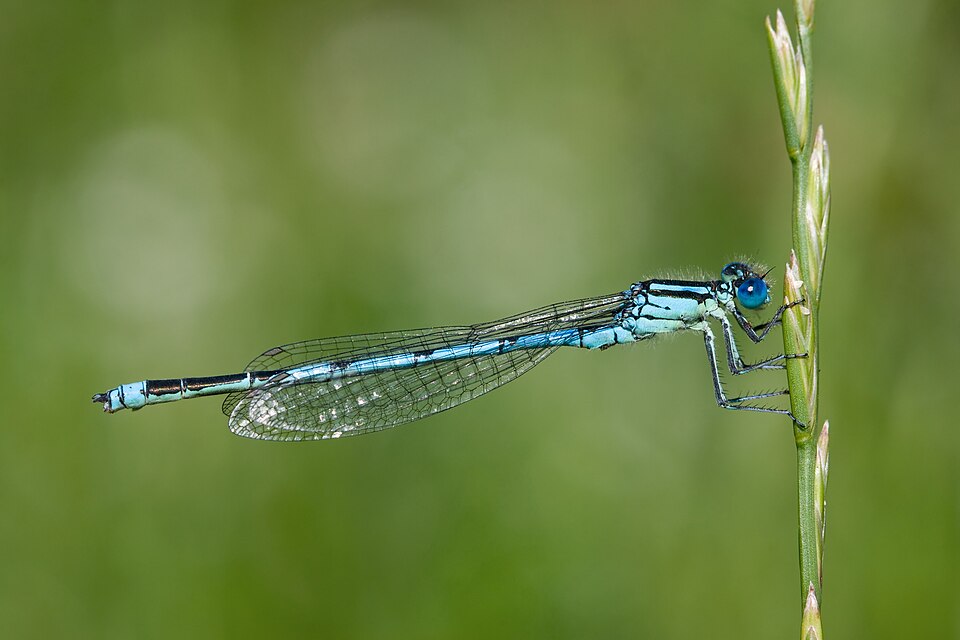
The goblet-marked damselfly is a slim damselfly, blue and black or green and black. The male has very bright blue eyes, so people also call it the blue-eye. It lives near ponds and other waters in southern and western Europe.
How fast is it?
Fun facts
The male's eyes are such a bright blue that the blue-eye is one of its names.
The male has spear-shaped marks along the middle of his long, thin tail.
It is quite common in southern and western Europe, but it does not live in Britain, Scandinavia or eastern Europe.
Scientists have moved it between groups twice, so it has had three different scientific names.
Most asked questions about Goblet-marked damselfly
?Is the goblet-marked damselfly dangerous?
No. Damselflies cannot sting or hurt people.
?Why is it called the blue-eye?
Because the male has very bright blue eyes.
For bug experts
- Scientific name
- Erythromma lindenii
- Named by
- Selys, 1840
- Group
- Dragonflies and damselflies
- Family
- Coenagrionidae
- Classification
- Insecta > Odonata > Coenagrionidae
- Lives on
- Europe, Asia, Africa
- Also known as
- Blue-eye
Where the facts come from
- Goblet-marked damselfly (Wikipedia, CC BY-SA 4.0): what it looks like, where it lives, what it eats, sizes and fun facts, retold in simple words.
- Picture by Loz (L. B. Tettenborn). CC BY-SA 3.0, Wikimedia Commons. The sticker of this bug is drawn from this picture.
If we got something wrong, sorry, we are bug fans, not a science journal. Tell us at [email protected] and we will fix it.
Bug Wiki honey jar For grown-ups: Bug Wiki is free, with no ads and no tracking. A small tip helps keep it online.Leave a tip Emperor dragonfly
 Common whitetail
 Green darner
 Ebony jewelwing
 Globe skimmer
 Blue dasher
 Emergent mayfly
 Willow leaf beetle
 Stone spider
 Water veneer
 Single-dotted wave
 Grass eggar
.jpg)