
Greater arid-land katydid
Neobarrettia spinosa

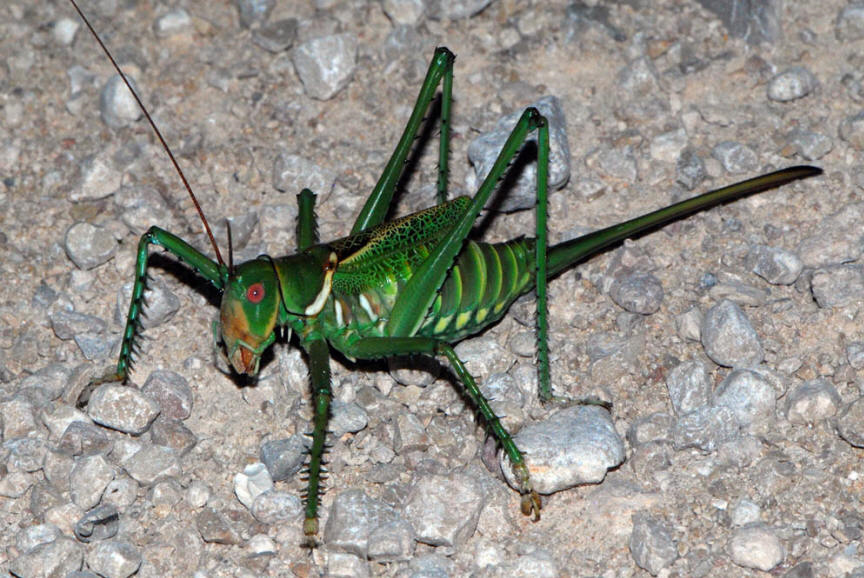
The greater arid-land katydid is a big katydid with red eyes that lives in dry brushland. Unlike most of its plant-eating cousins, it is a hunter. It creeps through the bushes looking for other animals to catch.
Lives in
The southwestern United States and northern Mexico, in dry deserts with bushes and in oak and juniper woods
Can it hurt you?
Can bite
It can give a strong bite and a hard kick if it is grabbed. Watch it, but do not pick it up.
What does it eat?
It eats grasshoppers, other katydids, caterpillars, small frogs, lizards and any small animal it can overpower.
How fast is it?
Greater arid-land katydid about 3 km/h (1.9 mph)
A person walking about 5 km/h (3.1 mph)
A kid running fast about 13 km/h (8.1 mph)
A grown-up on a bike about 25 km/h (16 mph)
cool stuff
Fun facts
1
It even hunts a rare little songbird, the black-capped vireo.
2
When something attacks it, it puts on a scary pose to warn the enemy.
3
Because of its red eyes, some people call it the red eyed devil.
you asked
Most asked questions about Greater arid-land katydid
?Is the greater arid-land katydid dangerous?
It can bite hard and kick if you pick it up, but it is not dangerous if you leave it alone.
?What does the greater arid-land katydid eat?
Other insects, and even small frogs and lizards.
For bug experts
- Scientific name
- Neobarrettia spinosa
- Group
- Grasshoppers and crickets
- Family
- Tettigoniidae
- Classification
- Insecta > Orthoptera > Tettigoniidae
- Lives on
- North America
- Also known as
- Red eyed katydid, Red eyed devil, Giant Texas katydid
Where the facts come from
- Neobarrettia spinosa (Wikipedia, CC BY-SA 4.0): what it looks like, where it lives, what it eats, sizes and fun facts, retold in simple words.
- Picture by Red screen65. CC BY-SA 4.0, Wikimedia Commons. The sticker of this bug is drawn from this picture.
If we got something wrong, sorry, we are bug fans, not a science journal. Tell us at [email protected] and we will fix it.
Bug Wiki honey jar For grown-ups: Bug Wiki is free, with no ads and no tracking. A small tip helps keep it online.Leave a tip Desert locust
 House cricket
 Parktown prawn
 Eastern lubber grasshopper
 Australian plague locust
 Mormon cricket
 Elegant chinchemolle
 Black sorrow cicada
 Sagebrush checkerspot
 Large creosote gall midge
 Sagebrush woolly stem gall midge
 Deathstalker