
Hairy rose beetle
Tropinota squalida

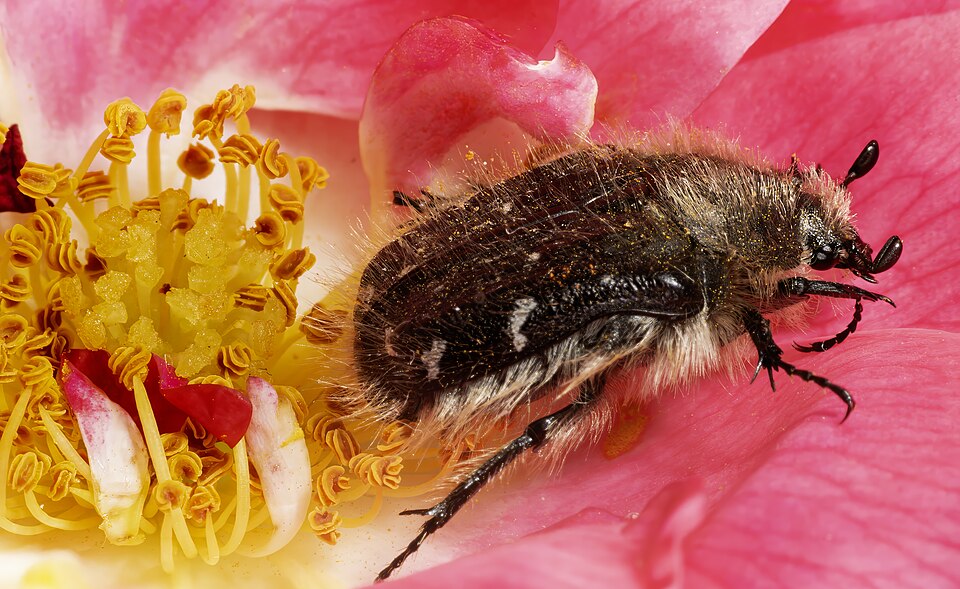
The hairy rose beetle is a dark brown beetle covered in thick, long tawny hair. It has white spots on its back. In late spring it crawls into flowers to eat them.
Lives in
Southern Europe, the Near East and North Africa
Length
1 to 1.5 cm (0.39 to 0.59 in)
Can it hurt you?
Harmless
Harmless to people, but gardeners do not like it.
What does it eat?
The beetles eat flowers, especially of fruit trees, roses and strawberries. The larvae eat roots under the ground.
How big is it?
How long is it?
🍚as long as 2.5 grains of rice in a row🍽️could run across a dinner table in 7.2 seconds
How big is Hairy rose beetle compared to YOU?
Just maths in your browser. Nothing is saved or sent anywhere.
How fast is it?
A garden snail about 0.05 km/h (0.03 mph)
A tortoise about 0.3 km/h (0.19 mph)
Hairy rose beetle about 0.5 km/h (0.31 mph)
A person walking about 5 km/h (3.1 mph)
cool stuff
Fun facts
1
It eats the whole middle of a flower, so no fruit can grow there afterwards.
2
After eating, it goes back into the soil, and comes out again a few days later when it is warm.
3
You can see the beetles from May to July.
4
It does not live in North or South America.
you asked
Most asked questions about Hairy rose beetle
?What does the hairy rose beetle eat?
Flowers of fruit trees, roses, irises and strawberries. Its larvae eat roots.
?How big is the hairy rose beetle?
About 10 to 15 millimetres long.
For bug experts
- Scientific name
- Tropinota squalida
- Named by
- Scopoli, 1783
- Group
- Beetles
- Family
- Scarabaeidae
- Classification
- Insecta > Coleoptera > Scarabaeidae
- Lives on
- Europe, Asia, Africa
Where the facts come from
- Tropinota squalida (Wikipedia, CC BY-SA 4.0): what it looks like, where it lives, what it eats, sizes and fun facts, retold in simple words.
- Picture by Didier Descouens. CC BY-SA 4.0, Wikimedia Commons. The sticker of this bug is drawn from this picture.
If we got something wrong, sorry, we are bug fans, not a science journal. Tell us at [email protected] and we will fix it.
Bug Wiki honey jar For grown-ups: Bug Wiki is free, with no ads and no tracking. A small tip helps keep it online.Leave a tip Stag beetle
 Hercules beetle
 Common glow-worm
 Goliath beetle
 Cockchafer
 Mealworm beetle
 Meadow grasshopper
 Crotch's bumble bee
 Mazarine blue
 Spring field cricket
 Great purple hairstreak
 Yellow-banded bumblebee
_Tropinota_squalida_on_Rosa_chinensis.jpg)