

Hornfaced bee
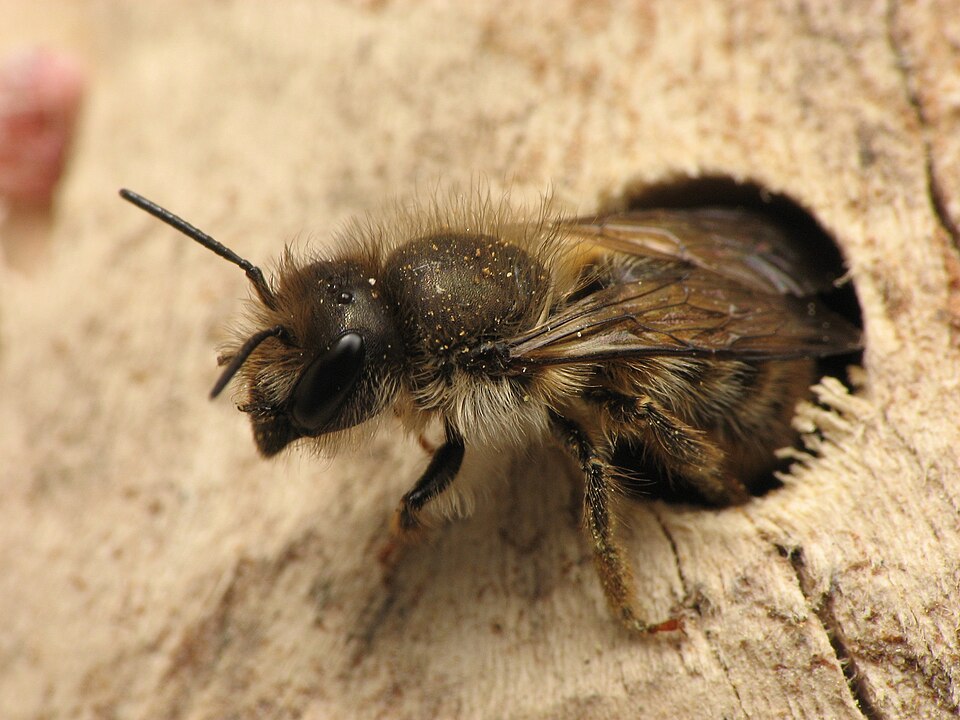
The hornfaced bee is a small bee from East Asia with two little horns on its lower face. It lives alone, not in a big hive. Farmers love it because it is a super helper in apple orchards.
How fast is it?
Fun facts
One bee can visit up to 2,500 flowers in a single day.
Japanese farmers began using it in the 1940s, and later more than half of Japan's apple orchards used it.
It was brought to the United States in 1977 to help pollinate fruit trees.
It stays home when it rains, because it does not fly well in wet weather.
The boys come out of their nests in April, just before the apple trees bloom, and the girls follow two or three days later.
Most asked questions about Hornfaced bee
?Why is it called hornfaced bee?
Because it has two small horn-like bumps on its lower face.
?Why do farmers like the hornfaced bee?
It pollinates flowers very fast, so fruit trees like apples give more fruit.
For bug experts
- Scientific name
- Osmia cornifrons
- Group
- Bees and bumblebees
- Family
- Megachilidae
- Classification
- Insecta > Hymenoptera > Megachilidae
- Lives on
- Asia, North America
- Also known as
- Horned-face bee
Where the facts come from
- Osmia cornifrons (Wikipedia, CC BY-SA 4.0): what it looks like, where it lives, what it eats, sizes and fun facts, retold in simple words.
- Picture by Beatriz Moisset. CC BY-SA 3.0, Wikimedia Commons. The round sticker of this bug is cut from the same picture.
If we got something wrong, sorry, we are bug fans, not a science journal. Tell us at [email protected] and we will fix it.
 Western honey bee
 Buff-tailed bumblebee
 Violet carpenter bee
 Giant honey bee
 Wallace's giant bee
 Himalayan giant honey bee
 Tersa sphinx
 Ailanthus silkmoth
 Samurai wasp
 Bull ant
 Peach-potato aphid
 Giant Palouse earthworm