

Indian moon moth
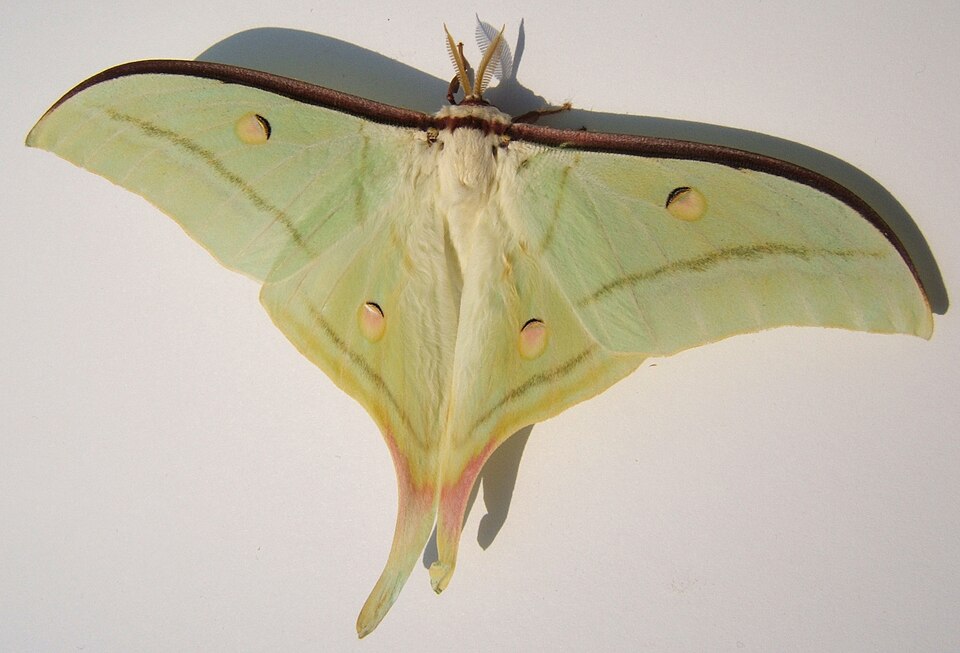
The Indian moon moth is a big, beautiful moth with pale green wings and long, swishy tails on its back wings. Each wing has a round eye spot, and the front edges are pink. It flies mostly at night.
How fast is it?
Fun facts
Its caterpillars start out red and black and only turn green when they are a bit older.
The grown-up caterpillar is apple green with yellow spiky bumps.
It spins a pale brown, egg-shaped cocoon.
Many people raise it at home from eggs or cocoons.
It has even been crossed with the Spanish moon moth.
Most asked questions about Indian moon moth
?What does the Indian moon moth eat?
The moths do not eat at all. The caterpillars eat the leaves of many trees and bushes.
?When does the Indian moon moth fly?
Mostly at night.
?Where does the Indian moon moth live?
In Asia, from India and Sri Lanka to Japan and the islands of Southeast Asia.
For bug experts
- Scientific name
- Actias selene
- Named by
- Hübner, 1807
- Group
- Moths
- Family
- Saturniidae
- Classification
- Insecta > Lepidoptera > Saturniidae
- Lives on
- Asia
- Also known as
- Indian luna moth
Where the facts come from
- Actias selene (Wikipedia, CC BY-SA 4.0): what it looks like, where it lives, what it eats, sizes and fun facts, retold in simple words.
- Picture by No machine-readable author provided. Kugamazog~commonswiki assumed (based on copyright claims).. CC BY-SA 2.5, Wikimedia Commons. The round sticker of this bug is cut from the same picture.
If we got something wrong, sorry, we are bug fans, not a science journal. Tell us at [email protected] and we will fix it.
 Atlas moth
 Luna moth
 Hummingbird hawk-moth
 Domestic silk moth
 Isabella tiger moth
 Polyphemus moth
 Red-headed ash borer
 Oak marble gall wasp
 Pellucid fly
 New Forest cicada
 Ringlet butterfly
 Double drummer