

Large bee-fly
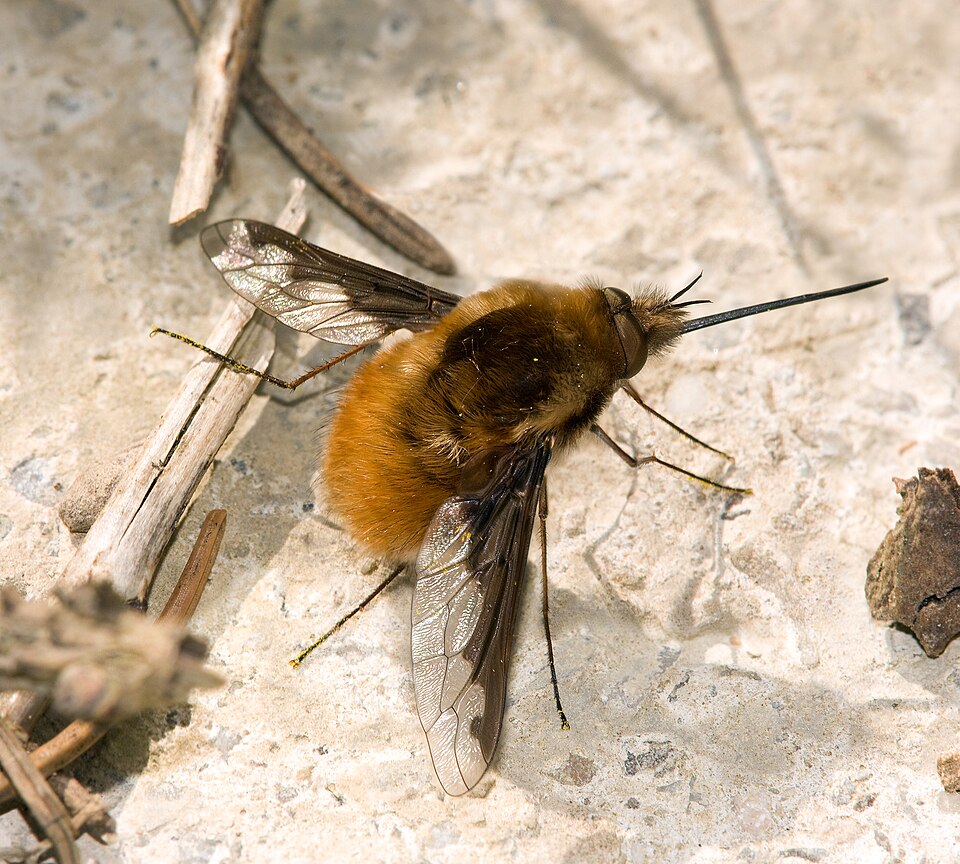
The large bee-fly is a round, fluffy fly that looks like a little bumblebee. It has a long, stiff beak in front and wings with a dark front half. It hovers in front of spring flowers with its long legs dangling, and makes a high buzzing sound.
How big is it?
How long is it?
How wide are its wings?
How big is Large bee-fly compared to YOU?
Just maths in your browser. Nothing is saved or sent anywhere.
How fast is it?
Fun facts
Its long beak is only for drinking nectar, like a straw.
You can tell it is a fly and not a bee, because it has only one pair of wings.
The mother flicks her eggs at the entrance of a solitary bee's nest while she hovers.
Before laying, she dips her rear end in dust to coat her eggs.
It is one of the first insects of spring, flying from about the end of March to June.
Most asked questions about Large bee-fly
?Can a bee-fly sting you?
No. The bee-fly does not bite or sting, even though it looks like a bee and has a long beak.
?Is the bee-fly a bee or a fly?
It is a fly. It just looks like a bumblebee, which helps protect it from hungry birds.
?What does the bee-fly eat?
The grown-ups drink nectar and eat pollen from flowers.
For bug experts
- Scientific name
- Bombylius major
- Group
- Flies and mosquitoes
- Family
- Bombyliidae
- Classification
- Insecta > Diptera > Bombyliidae
- Lives on
- Europe, North America, Asia
- Also known as
- Dark-edged bee-fly, Greater bee fly
Where the facts come from
- Bombylius major (Wikipedia, CC BY-SA 4.0): what it looks like, where it lives, what it eats, sizes and fun facts, retold in simple words.
- Picture by Richard Bartz , Munich aka Makro Freak. CC BY-SA 2.5, Wikimedia Commons. The round sticker of this bug is cut from the same picture.
If we got something wrong, sorry, we are bug fans, not a science journal. Tell us at [email protected] and we will fix it.
 Housefly
 New World screwworm fly
 Lovebug
 Tsetse fly
 Common fruit fly
 Asian tiger mosquito
 Common harvestman
 Red bull ant
 Rosy wolfsnail
 Common eastern bumblebee
 Tawny crazy ant
 Green-head ant